Stop 12 / 12 · kingdom · ≈ 850 – 1335
Uyghur kingdom of Qocho
An idiqut state that lasted four centuries.
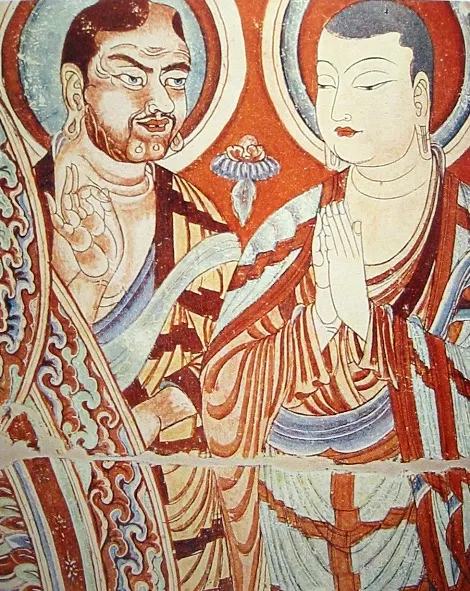
The Uyghur kingdom of the Turfan oasis, where Buddhists, Manichaeans and Christians lived side by side and Uyghur scribes wrote the books that later taught the Mongols to write. Founded after the fall of the Orkhon khaganate in 840, it was ruled by idiquts from Qocho (today Karahoja, near Turfan) in summer and Beshbaliq in winter; the Bezeklik paintings are of its time. It submitted to Chinggis Khan of its own will in 1209 and lost Turfan to the Muslim khans of Moghulistan in the 1390s.

How did it begin?
With a flight. In 840 the Kyrgyz destroyed the Uyghur khaganate on the Orkhon, and the Uyghur tribes scattered. The Persian historian Juvaini wrote that wherever they stopped they heard the cry 'köch, köch' (move on, move on), until they reached the plain where they built Beshbaliq, and there the cry fell silent. One group went to the Gansu corridor and founded the Ganzhou (today Zhangye) kingdom; another came to the Turfan basin and the northern slopes of the Tianshan, which the Tibetans then held.
In 866 the Uyghur chief Pugu Jun took Beshbaliq, Qocho and the neighbouring towns from them. His successors, the idiquts ('holy fortune'), kept the nomads' rhythm: Beshbaliq, where the herds pastured all year, was the winter capital, and Qocho near Turfan the summer one. Their land ran from Kumul in the east to Kucha in the west.
Sources: James A. Millward, Eurasian Crossroads: A History of Xinjiang (London: Hurst, 2007) · Sima Guang, Zizhi tongjian (Comprehensive Mirror), chapter 250, Chinese original on Wikisource · Xin Tangshu (New History of the Tang), chapter 217B: the Uyghurs (second part), Chinese original on Wikisource
How did people live there?
The Song envoy Wang Yande, who visited in the 980s, left a lively picture. Summers are so hot that people dig rooms into the ground; canals from the Golden Mountains water the fields around the city and turn the mills; houses are plastered white. People love riding and archery, play the lute and the harp, and carry their instruments when they go out; in spring they splash each other with water to drive illness away. There are more than fifty Buddhist monasteries, holding the Buddhist canon and Chinese dictionaries, and a Manichaean temple with Persian priests. 'There are no poor in the land,' he wrote; 'those who run out of food are fed by all.' At Beshbaliq craftsmen work gold, silver, copper and iron and cut jade, and even the poor eat meat.
Behind this stood a culture of writing. The Uyghurs wrote their own language in a script taken from the Sogdians, translated Buddhist, Manichaean and Christian texts into it, and painted the cave temples of Bezeklik.
Sources: Song shi (History of the Song), chapter 490: Gaochang and the Uyghurs (with Wang Yande's report), Chinese original on Wikisource · James A. Millward, Eurasian Crossroads: A History of Xinjiang (London: Hurst, 2007) · Samuel N. C. Lieu, “Chinese Turkestan vii. Manicheism in Chinese Turkestan and China”, Encyclopaedia Iranica (1991)
How did it end, and what did it leave?
Not by conquest, at first. In 1209 the idiqut Barchuq Art Tegin killed the Qara Khitay overseer, threw his head from a tower window and submitted to Chinggis Khan of his own will, the first ruler to do so; Chinggis gave him a daughter and called him his fifth son. Uyghur scribes then taught the Mongols to write: the Mongol script is the Uyghur script, and Uyghur officials served the Mongol empire from China to Iran.
But the kingdom was caught between Mongol princes. In 1275 Duwa besieged Qocho for six months, and later idiquts moved to Gansu to serve the Yuan court. In the 1390s Khizr Khwaja, the Muslim khan of Moghulistan, took Turfan and Qocho in a holy war; Buddhism faded slowly over the next half-century. What Qocho left is a written world: thousands of manuscripts and paintings that explorers carried from Qocho, Bezeklik and the Turfan oasis to Berlin, London, St Petersburg and Kyoto, still being read today.
Sources: James A. Millward, Eurasian Crossroads: A History of Xinjiang (London: Hurst, 2007) · Yuan shi (History of the Yuan), chapter 122: Barchuq Art Tegin, Chinese original on Wikisource · Mirza Muhammad Haidar Dughlat, The Tarikh-i-Rashidi: A History of the Moghuls of Central Asia, tr. E. Denison Ross, ed. N. Elias (London, 1895) · Werner Sundermann, “Turfan Expeditions”, Encyclopaedia Iranica (2004)
Sources (8)
- James A. Millward, Eurasian Crossroads: A History of Xinjiang (London: Hurst, 2007) · cited only
- Sima Guang, Zizhi tongjian (Comprehensive Mirror), chapter 250, Chinese original on Wikisource · public domain
- Xin Tangshu (New History of the Tang), chapter 217B: the Uyghurs (second part), Chinese original on Wikisource · public domain
- Song shi (History of the Song), chapter 490: Gaochang and the Uyghurs (with Wang Yande's report), Chinese original on Wikisource · public domain
- Samuel N. C. Lieu, “Chinese Turkestan vii. Manicheism in Chinese Turkestan and China”, Encyclopaedia Iranica (1991) · cited only
- Yuan shi (History of the Yuan), chapter 122: Barchuq Art Tegin, Chinese original on Wikisource · public domain
- Mirza Muhammad Haidar Dughlat, The Tarikh-i-Rashidi: A History of the Moghuls of Central Asia, tr. E. Denison Ross, ed. N. Elias (London, 1895) · public domain
- Werner Sundermann, “Turfan Expeditions”, Encyclopaedia Iranica (2004) · cited only