Stop 4 / 13 · statesman · 1883 – 1934
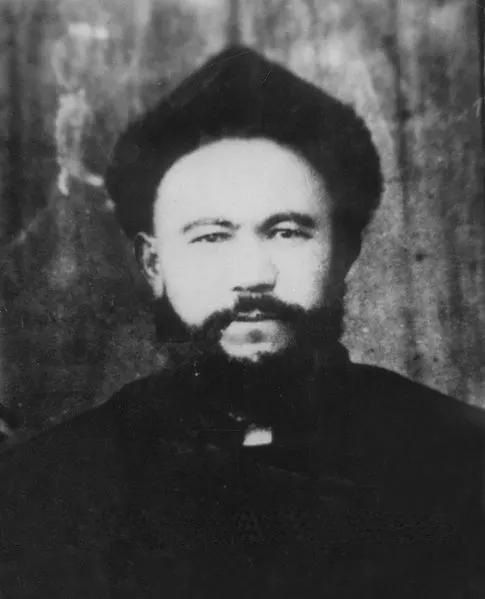
Sabit Damolla
A scholar from Artush who wanted a state.
The religious scholar who proclaimed the East Turkistan Islamic Republic at Kashgar in 1933 and served as its prime minister, and who died after its fall in 1934.

What kind of republic did he want?
A modern one as much as an Islamic one. On 12 November 1933 Sabit Damolla presided over a rally of some 7,000 troops and 13,000 people on the Tümen river at Kashgar, with schoolchildren and teachers in front. A cannon fired forty-one times, the crowd waved blue flags and students sang 'Our flag is a blue flag … Turkestan is the homeland of our Turk people.' Then he led a parade to the Id Kah mosque, where the leaders spoke from its roof and minaret. The printed programme promised peace and security and assured foreigners they would not be troubled; it invoked God at the start and end, but its tone was not religious overall.
The Japanese scholar Shinmen, reading the republic's own papers, shows that most of its leaders were teachers and merchants of Kashgar and Artush from the new-method school movement, not men from Khotan. Sabit himself was a publisher and writer from Artush whose press Yang Zengxin had shut down. The first coins were struck for a 'Republic of Uyghuristan'; the name 'East Turkistan' was chosen after debate, because the new state held other Turkic peoples too.
Sources: James A. Millward, Eurasian Crossroads: A History of Xinjiang (London: Hurst, 2007)
How did he die?
Betrayed by his own president. When the Hui troops took Kashgar in early 1934, Sabit and other ministers fled to Yengisar and Yarkand. There Khoja Niyaz, who had made his own deal with Soviet agents and Sheng Shicai, took him prisoner and handed him over at Aksu. He was hanged there that summer. He had met Muhammad Amin Bughra years earlier, when both were coming home from the pilgrimage to Mecca, and in July 1933 had come to Kashgar with Bughra's brother to open the Khotan government's office, from which the republic grew.
Sources: James A. Millward, Eurasian Crossroads: A History of Xinjiang (London: Hurst, 2007) · Andrew D. W. Forbes, Warlords and Muslims in Chinese Central Asia (1986)
Sources (3)
- James A. Millward, Eurasian Crossroads: A History of Xinjiang (London: Hurst, 2007) · cited only
- Andrew D. W. Forbes, Warlords and Muslims in Chinese Central Asia (1986) · cited only
- Wikidata · cited only