Stop 4 / 11 · religious leader
Jahangir Khoja
A khoja who wanted his grandfather's throne back.
The khoja who came back from exile and in 1826 took Kashgar from the Qing, and who ended his life executed in Beijing. Grandson of Burhan ad-Din Khoja and heir of the Afaqi khojas, he raided Kashgaria from Kokand several times; he was defeated in 1827 and later captured.

How did he win Kashgar back?
By escaping, coming back, and escaping again. Jahangir, a grandson of the Afaqi khojas who had fled in 1759, was kept under watch in Kokand. In 1820 he got away and led a band of Kirghiz from the mountains on a raid towards Kashgar, but Qing forces drove him back. Two years later an earthquake gave him a chance to slip out of house arrest again, and another raid failed in 1825. From a base in the mountains outside Kashgar he stayed in secret touch with the Afaqis in the city, who sent him money for the war.
In the summer of 1826 he came again with a larger army of Kirghiz and Kokandis, and this time he had local support. He stopped first at Artush to visit the shrine of Satuq Bughra Khan, the first Karakhanid ruler to become a Muslim; then he took Kashgar's old city and, with the help of local Muslims, Yengisar, Yarkand, Khotan and Aksu as well. The Qing citadels in each city held out for a time, but after long sieges all of them fell except Aksu's, with much slaughter of Qing troops, Chinese merchants and Uyghur begs.
Sources: James A. Millward, Eurasian Crossroads: A History of Xinjiang (London: Hurst, 2007)
How did it end, and what did it leave behind?
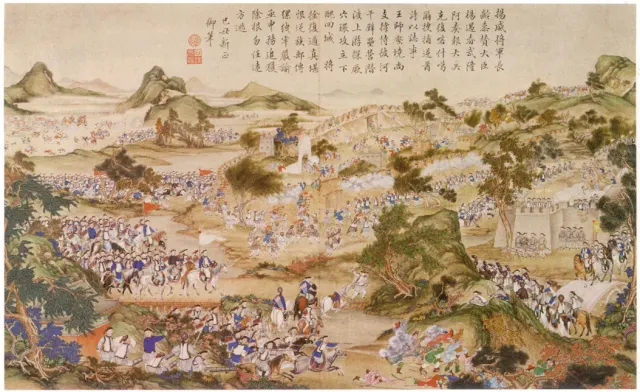
With a defeat that began with a duel. According to the local history in Forsyth's report, when the Qing army approached Kashgar, Jahangir sent out fifty thousand men. The armies met at Yangabad, and, as was the custom, each side put forward a champion for single combat: for the Chinese a giant Kalmyk archer dressed like a dragon, for Jahangir a famous Kokandi warrior in silks and chain mail. While the Kokandi was still adjusting his rifle, the Kalmyk shot an arrow through his chest and he fell dead; the disheartened Kashgar army broke and fled. Jahangir escaped with seven followers into the mountains; Kirghiz nomads pointed out his hiding place, and a Kirghiz chief who had once been his ally betrayed him. He was taken to Beijing and executed by slicing.
What he left behind can still be seen in Kashgar. With money confiscated from Kokandi merchants and Jahangir's local supporters, the Qing rebuilt their westernmost cities and built stronger forts behind high earthen walls, at some distance from the old Muslim quarters; Chinese merchants settled in between. Even today, Millward notes, the neighbourhoods east of the old town around the Id Kah mosque grow newer and more Han the further one goes. According to the history in Forsyth's report, twelve thousand Muslim families were moved from Kashgar to Ghulja after the revolt and settled there as labourers, under the name taranchi. In 1830 his brother Yusuf Khoja came back with another army from Kokand.
Sources: T. D. Forsyth, Report of a Mission to Yarkund in 1873 (Calcutta, 1875) · James A. Millward, Eurasian Crossroads: A History of Xinjiang (London: Hurst, 2007)