kingdom · until 658
Kingdom of Kucha
كۇچار خانلىقى
The richest oasis of the Tarim, whose painted caves at Kizil, music and monk Kumarajiva became famous far beyond it; it wrote in Tocharian, a language forgotten until its manuscripts were found.
A Buddhist kingdom.
What made Kucha famous?
Its wealth, its temples and one of its sons. A Chinese account of the 3rd–4th centuries describes a city with three rings of walls, a thousand Buddhist temples and stupas, men and women who cut their hair at the neck, and a palace 'glittering like an abode of the gods'. Kucha was rich enough to be plundered on a grand scale: when the general Lü Guang took it in 384, he needed 20,000 camels to carry the loot back east.
He also carried off Kumarajiva. Born in Kucha to an Indian father and a Kuchean mother, he went with his mother to Kashmir at nine to study, turned to Mahayana Buddhism on the way home at Yarkand, and was famous across Central Asia and north China before he was grown. Taken east, he spent the rest of his life training disciples and translating Buddhist scriptures into Chinese; his translations shaped Chinese Buddhism for centuries.
Sources: James A. Millward, Eurasian Crossroads: A History of Xinjiang (London: Hurst, 2007)
What did Kucha give the world?
Painted caves, music and a lost language. In the cliffs at Kizil, near Kucha, local nobles and rich merchants paid for caves to be cut and painted from at least the 3rd century until the Tang conquest, with Buddhas and scenes from scripture that draw on Sogdian, Gandharan, Indian and Iranian art; their green and blue palette, Millward notes, is Kucha's own. Its musicians were the fashion of the Tang court, which was passionate about Kuchean music.
Kucha also wrote in Tocharian, an Indo-European language known only from manuscripts of the 1st millennium CE found in the northern Tarim, and probably one of the earliest branches to split from the Indo-European family. The kingdom's independence ended in the 640s, when Tang armies took it by force; the Tang then made Kucha the seat of its Anxi Protectorate.
Sources: James A. Millward, Eurasian Crossroads: A History of Xinjiang (London: Hurst, 2007)
Events
- 73Ban Chao in the Western Regionsbattle · Site of Loulan
- 384Lü Guang takes Kuchabattle · Kucha
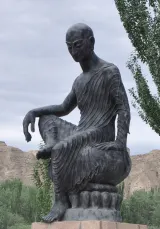
- ≈ 401Kumārajīva reaches Chang'anevent · Xi'an
- ≈ 600The Western Turks rule the oasesevent · Qocho
- ≈ 648The Tang take Kuchafall · Kucha
- 798The Uyghurs fight at Kuchabattle · Kucha
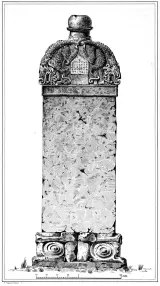
- 1347Islam reaches Kuchaconversion · Mazar of Molana Arshidinhan · disputed
People of this time
Sources (1)
Years are approximate; they will be checked against a second source.