monk · 344 – 409/413 most likely
Kumārajīva
كۇماراجىۋا
The monk from Kucha whose Chinese translations of the Buddhist scriptures, made in Chang'an (today Xi'an) after 401, are still the ones Chinese Buddhists read.
An emperor sent an army to fetch him.
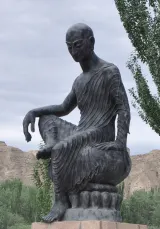
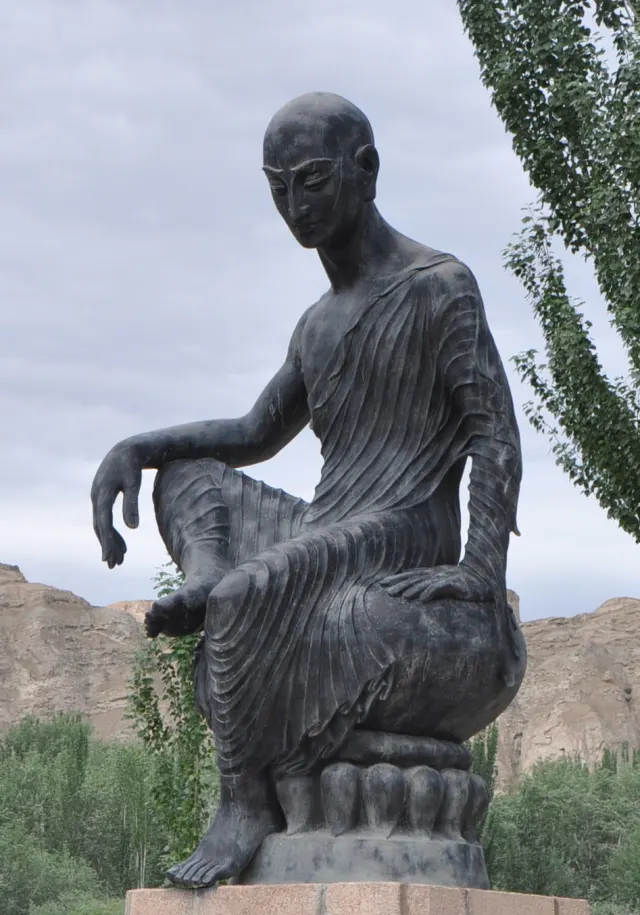

Life and works
- 344BornKucha
- 384battleLü Guang takes KuchaAn emperor sends 70,000 men to fetch one monk.
- ≈ 401 – 402eventKumārajīva reaches Chang'anKumārajīva's translations, still read today, are made.
- 409 / 413 · disputedDiedKumārajīva
Why did a ruler send an army for one monk?
Because his learning was famous across Asia. In 382 Fu Jian, ruler of northern China, sent his general Lü Guang west with 70,000 men, and, the monk's biography says, told him: if you take Kucha, send Kumārajīva to me at once. The rulers of Turfan and Shanshan had invited the conquest. The army entered Kucha in 384, found huge wine cellars in people's houses, and carried the monk off; according to the Book of Sui, Kuchean music reached China with this conquest. Fu Jian's state collapsed before the monk arrived, and Lü Guang kept him in Liangzhou for seventeen years; the biography says Lü even forced him to marry a Kuchean princess.
Only in 401 did the new ruler Yao Xing bring him to Chang'an. There, he translated more than three hundred scrolls of Buddhist scripture into a Chinese so clear that his versions are still the ones read today. His biography ends with a test he set himself: if his translations were true, his tongue would not burn when his body was cremated; it did not.
Sources: Huijiao, Gaoseng zhuan (Biographies of Eminent Monks), chapter 2: Kumārajīva, Chinese original on Wikisource · Chao-jung Ching, “Kucha”, Encyclopaedia Iranica (2021) · Sui shu (Book of Sui), chapter 15: Music, Chinese original on Wikisource
Disputed · views side by side
In which year did Kumārajīva die?
413
The eulogy by his pupil Sengzhao: the guichou year (413), aged seventy.
Sengzhao, Eulogy for the Dharma Master Kumārajīva, in Guang Hongming ji chapter 23, Chinese original on Wikisource
409
The Biographies of Eminent Monks (6th century): Hongshi 11 (409); its author adds that other records say Hongshi 7 or 8 (405 or 406) and that he cannot decide.
Huijiao, Gaoseng zhuan (Biographies of Eminent Monks), chapter 2: Kumārajīva, Chinese original on Wikisource
The views stand side by side; the reader decides.
Sources (5)
- Huijiao, Gaoseng zhuan (Biographies of Eminent Monks), chapter 2: Kumārajīva, Chinese original on Wikisource · public domain
- Chao-jung Ching, “Kucha”, Encyclopaedia Iranica (2021) · cited only
- Sui shu (Book of Sui), chapter 15: Music, Chinese original on Wikisource · public domain
- Wikidata · cited only
- Sengzhao, Eulogy for the Dharma Master Kumārajīva, in Guang Hongming ji chapter 23, Chinese original on Wikisource · public domain
Years come from Wikidata only and are not yet checked against a second source.