Stop 4 / 11 · painting
The silk princess panel
The princess who hid silkworms in her headdress.
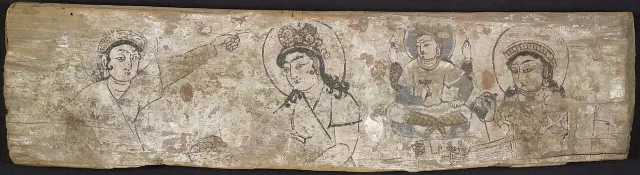
The panel that seems to show how silk came to Khotan: a Chinese princess, married to the king of Khotan, hid silkworm eggs in her headdress, the legend Xuanzang recorded. Aurel Stein found the painted wooden panel at Dandan Oilik in 1900; it is now in the British Museum.

What exactly is painted on it?
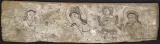
A scene from a story every Khotanese knew. In the middle sits a princess in a tall headdress, her eyes turned down to a basket heaped with cocoons, her right arm stretched out over them as if to protect them. An attendant points at her headdress; another works at a loom; a divine figure sits behind. Stein read it as the legend Xuanzang recorded in 644: the king of Khotan, refused silkworms by China, asked for a Chinese princess as bride and let her know that if she wanted silk robes in Khotan she had better bring silkworms herself. She hid mulberry seeds and silkworm eggs in the lining of her headdress, which the frontier guards did not dare to search. Once queen, she had a law carved in stone: no cocoon could be unwound until the moth had flown.
Stein found the panel in a shrine at Dandan Oilik in 1900; it is in the British Museum. He also noted a western echo: the Byzantine story of monks who smuggled silkworm eggs to the emperor Justinian around 550, probably from Khotan.
Sources: Stein, Ancient Khotan (1907)
Sources (1)
- Stein, Ancient Khotan (1907) · public domain