ruler · ≈ 914 – ≈ 955 most likely
Sultan Satuq Bughra Khan
سۇلتان سۇتۇق بۇغراخان
The prince who, in the Kashgar legend, became a Muslim after watching merchants at Artush drop all business at the call to prayer, and the ruler with whom the Tarim Basin began its turn from Buddhism to Islam.
He then took Kashgar and made himself khan; gold coins he struck read 'Qarakhan Satuq Abdulkerim'. He died in 955 and is buried in Artush.

Life and works
- ≈ 914 – 920BornSultan Satuq Bughra Khan
- ≈ 932 – 933conversionSatuq Bughra Khan becomes a MuslimThe conversion that began the Tarim's turn from Buddhism to Islam.
- ≈ 955Diedburied here: Artush
How did Satuq become a Muslim?
The stories differ, and all of them are told in Kashgar. In the version Millward retells, a Samanid prince who had fled to Kashgar was made governor of Artush, a caravan station just outside the city, and built a mosque there. The young Satuq, inspecting caravan goods at Artush, saw the Muslim merchants stop all business and pray as soon as they heard the call; moved, he began to study the Qur'an. In another version a hare he is hunting turns into a shaykh and makes him repeat the creed.
Buğra tells it as a secret plot. In 932 a learned man of the Samanid house, Abu Nasr Samani, came to Artush at the head of a caravan; Satuq, out hunting, found the travellers at prayer, questioned Abu Nasr and became a Muslim in secret. Within months he had a hidden society of a few hundred armed young Muslims. On an agreed night, with forty companions, he seized his uncle and stepfather, the khan, in his own bedroom while the society's squads took the barracks of Kashgar. Then he declared himself khan with the title Bughra.
Millward adds a caution: the conversion of the Karakhanids was probably more gradual than the heroic story says, helped by scholars at court, Sufis on the steppe and Muslim merchants everywhere.
Sources: James A. Millward, Eurasian Crossroads: A History of Xinjiang (London: Hurst, 2007) · Mehmet Emin Buğra, Şarkî Türkistan Tarihi (1940), in Abdullah Oğuz, Şarkî Türkistan Tarihi: Metin Tenkidi, Türkiye Türkçesi ve İnceleme, MA thesis, İstanbul Üniversitesi (2020)
What came of it?
A new religion for the western Tarim, and a long war in the east. Once khan, Satuq defeated his uncle and, perhaps with Samanid help, took Balasagun (today Burana, Kyrgyzstan) from the senior Arslan khans. Buğra says the Samanids sent scholars, hadith teachers and jurists to Kashgar and Balasagun, and that Satuq took the Muslim name Abdulkerim: his gold coins read 'Qarakhan Satuq Abdulkerim'. Khotan, Kucha and the Uyghurs of Qocho (today Karahoja, near Turfan), still Buddhist, broke away. Buğra writes that Satuq took Khotan after a long siege and then Kucha, though their people stayed Buddhist, and that Khotan rose again after his death; Millward dates the final conquest of Khotan to shortly before 1006, under Yusuf Qadir Khan.
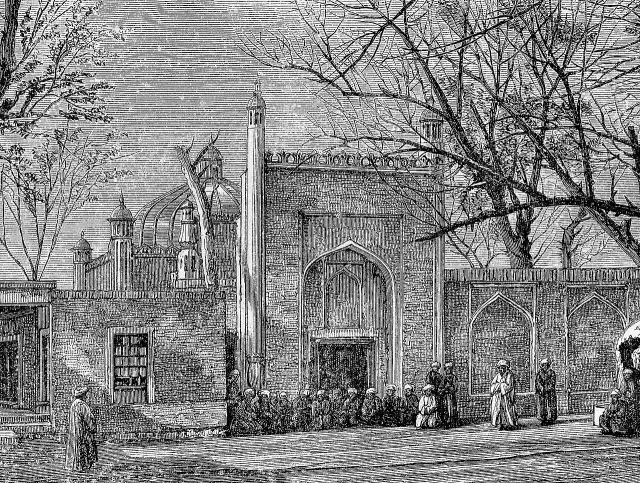
Satuq died in 955 after 22 years as khan, Buğra writes. Five years later, Islamic sources record the conversion of '200,000 tents of the Turks'. His tomb at Artush has remained a place of pilgrimage for a thousand years: Yaqub Beg rebuilt and endowed it in the 1870s.
Sources: James A. Millward, Eurasian Crossroads: A History of Xinjiang (London: Hurst, 2007) · Mehmet Emin Buğra, Şarkî Türkistan Tarihi (1940), in Abdullah Oğuz, Şarkî Türkistan Tarihi: Metin Tenkidi, Türkiye Türkçesi ve İnceleme, MA thesis, İstanbul Üniversitesi (2020)
Sources (4)
- James A. Millward, Eurasian Crossroads: A History of Xinjiang (London: Hurst, 2007) · cited only
- Mehmet Emin Buğra, Şarkî Türkistan Tarihi (1940), in Abdullah Oğuz, Şarkî Türkistan Tarihi: Metin Tenkidi, Türkiye Türkçesi ve İnceleme, MA thesis, İstanbul Üniversitesi (2020) · cited only
- Wikidata · cited only
- Michal Biran, “Qarakhanids”, Encyclopaedia Iranica (2004) · cited only
Years come from Wikidata only and are not yet checked against a second source.