kingdom · ≈ 460 – 640
Kingdom of Gaochang (Qu family)
گاۋچاڭ خانلىقى (چۈ جەمەتى)
The kingdom at Turfan that wrote in Chinese, worshipped the Buddha, paid tribute to the Turks and was full of Sogdian merchants, and whose king tried to keep the pilgrim Xuanzang for life.
Ruled by the Qu family of Chinese settlers in the 5th–7th centuries, it was taken by the Tang in 640. Same city as the later Uyghur kingdom of Qocho (today Karahoja, near Turfan), but a different state.
Why did the king of Gaochang try to keep a monk?
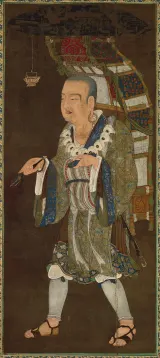
Because he wanted the most famous teacher of his age for his own kingdom. In about 629 the pilgrim Xuanzang reached Hami on his way to India. King Qu Wentai of Gaochang sent horses and ministers to fetch him, met him at midnight with torches, and told him he and his family had not slept for joy. Then he would not let him go. He promised to keep him for life and make all his people his disciples; when Xuanzang refused, the king, flushed with anger, threatened to hold him by force and send him back to China. Xuanzang answered that the king had power over his body but not his will, and for three days he would neither eat nor drink.
On the fourth day the king bowed to the ground and gave in. They swore brotherhood before the Buddha, and Xuanzang promised to stay three years on his way back. The king then equipped him as few travellers have been equipped: thirty horses, twenty-four servants, a hundred ounces of gold, thirty thousand silver coins, five hundred rolls of silk, and letters to twenty-four kingdoms on the road.
Sources: Hui Li, The Life of Hiuen-Tsiang, tr. Samuel Beal (London, 1888; new ed. 1911)
What kind of kingdom was it?
A crossroads in miniature. The court kept Chinese for its official papers, but the kingdom ruled itself. Its markets belonged to the Sogdians: of thirty-five commercial deals in a Gaochang tax register from the 620s, twenty-nine involved a Sogdian, and Sogdian farmers and craftsmen lived there too. Its safety depended on the Western Türks. The king's sister was married to the Yabghu Khan's eldest son, whom Xuanzang met at Kunduz, and the king sent Xuanzang on to the Khan himself with two cartloads of silk and fruit and a letter asking him to be kind to the monk 'as he has ever been kind to me'.
That balance could not last. In 640 Tang armies crushed the kingdom by force. Xuanzang, homeward bound years later, still told an Indian king he must take the northern road because he had promised to see Gaochang's king again; by the time he came back, in 644, Gaochang was gone. The same city later became the capital of the Uyghur kingdom of Koço, a different state.
Sources: James A. Millward, Eurasian Crossroads: A History of Xinjiang (London: Hurst, 2007) · Hui Li, The Life of Hiuen-Tsiang, tr. Samuel Beal (London, 1888; new ed. 1911)
Events
Sources (2)
Years are approximate; they will be checked against a second source.