Stop 10 / 11 · inscription
Karabalgasun inscription
A stone in three languages, one of them Sogdian.
The stone that tells how the Uyghur khagans took up the Manichaean religion, and many events known from nowhere else, in three languages: Old Turkic, Sogdian and Chinese. It was set up at the Uyghur capital on the Orkhon for the eighth khagan (r. 808–821); only fragments survive, found in 1889.
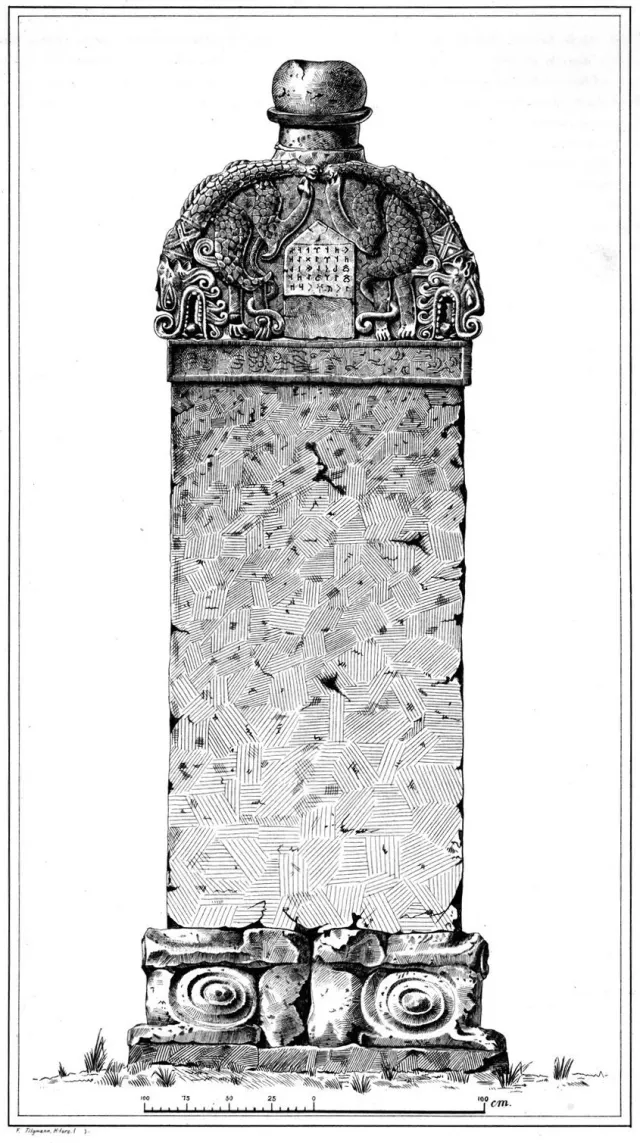

What does the stone tell?
The Uyghur khagans' own account of their dynasty, from the founders to the eighth khagan (r. 808–821) for whom it was raised. Two things stand out. First, the conversion: it tells how Bögü Khagan brought Manichaean teachers home from China in the 760s and made their religion the faith of the state, and how the khagans then supported it. Second, wars known from nowhere else, such as the seventh khagan's campaign in the 790s, when after besieging Beshbaliq he went on to Kucha and destroyed a Tibetan army; Yutaka Yoshida dates that battle to 798 from Khotanese documents. It is how we know that the Uyghurs, not the Tang, pushed the Tibetans out of the northern Tarim.
Sources: Yutaka Yoshida, “Karabalgasun ii. The Inscription”, Encyclopaedia Iranica (2010) · Samuel N. C. Lieu, “Chinese Turkestan vii. Manicheism in Chinese Turkestan and China”, Encyclopaedia Iranica (1991)
Why is it in three languages?
Because each language spoke to a different public: Old Turkic in runes to the Uyghurs themselves, Sogdian to the merchants, scribes and Manichaean clergy who ran much of the state's business and its religion, and Chinese to the Tang, its neighbour and customer. Set up at the capital Ordu Balïq on the Orkhon, it was broken long ago; only fragments survive, found in 1889, and the Chinese part is the best preserved. Its date of erection is itself disputed; the views stand side by side below.
Sources: Yutaka Yoshida, “Karabalgasun ii. The Inscription”, Encyclopaedia Iranica (2010) · Toshio Hayashi, “Karabalgasun i. The Site”, Encyclopaedia Iranica (2010)
Sources (3)
- Yutaka Yoshida, “Karabalgasun ii. The Inscription”, Encyclopaedia Iranica (2010) · cited only
- Samuel N. C. Lieu, “Chinese Turkestan vii. Manicheism in Chinese Turkestan and China”, Encyclopaedia Iranica (1991) · cited only
- Toshio Hayashi, “Karabalgasun i. The Site”, Encyclopaedia Iranica (2010) · cited only