Stop 1 / 11 · document
The Sogdian Ancient Letters
A mailbag lost on the road.
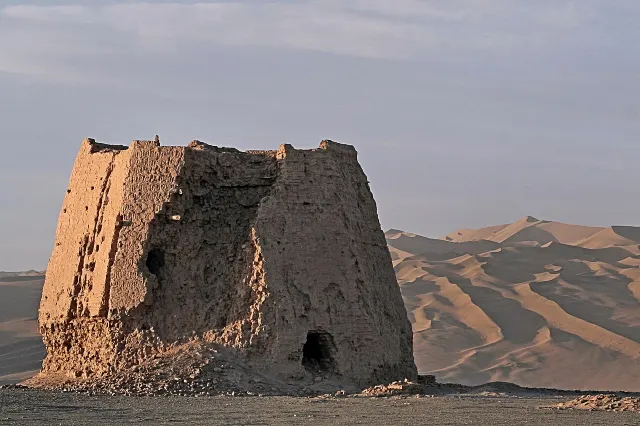
A lost mailbag of Sogdian merchants: letters about silver, gold, wine, pepper, camphor and musk, one addressed to Samarkand 3,000 km away, two written by a woman named Miwnay, stranded in Dunhuang, to her mother and her husband. Five nearly complete letters and some fragments, folded and addressed on the outside, were found in a ruined watchtower on the frontier wall between Dunhuang and Loulan. They are the oldest monuments of the Sogdian language.

What do the letters say?
Business, war and a woman's despair. Most are reports from Sogdian agents in China to merchants back home: silver, gold, pepper, camphor, musk and cloth. One letter tells of rumours that the Chinese emperor had fled his capital Luoyang and that Luoyang and Ye had been destroyed by the Huns, which the Iranist Henning matched with the sack of Ye in 307 and of Luoyang in 311, dating the letters to 312–313. In two others a woman called Miwnay, stranded in Dunhuang, writes to her mother and to the husband who had abandoned her; Another mentions '100 freemen from Samarkand' living in one Chinese city.
For history the letters matter twice. They are the oldest substantial texts in Sogdian, the language of the Silk Road's greatest traders, and they write the name of the Xiongnu as xwn, 'Hun', which goes a long way to show that the Huns of Europe and the Xiongnu of China bore the same name. When they were written is disputed; the views stand side by side below.
Sources: Nicholas Sims-Williams, “Ancient Letters”, Encyclopaedia Iranica II/1 (1985) · James A. Millward, Eurasian Crossroads: A History of Xinjiang (London: Hurst, 2007)