Stop 7 / 11 · ruler · ? – 779
Bögü Khagan
The khagan who came back from Luoyang with new teachers.
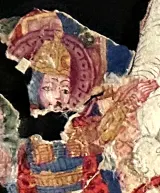
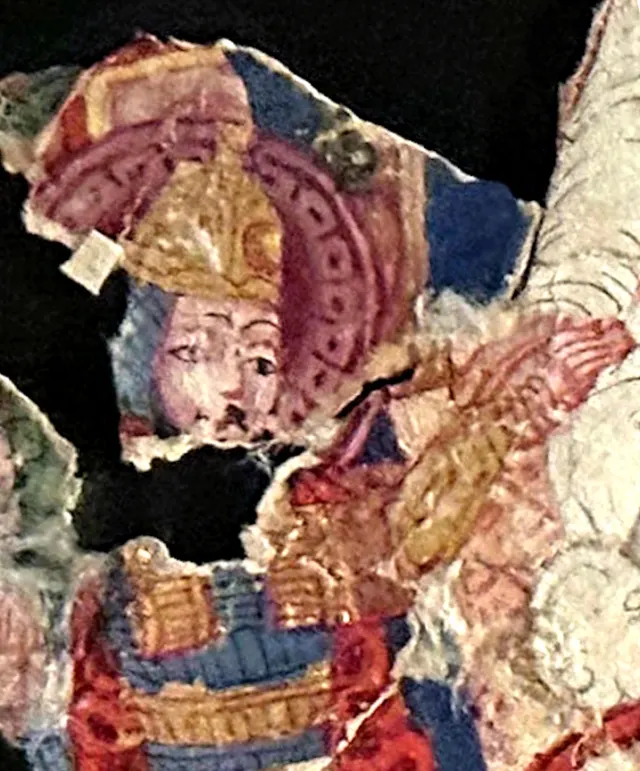
The khagan who brought Manichaean teachers home from Luoyang and made their faith the religion of the Uyghur court. Third khagan of the Uyghurs (r. 759–779) and son of Bayan Chor, he was killed in 779 by his minister Tun Bagha Tarqan when he planned to invade China.

Did he save the Tang, or rob it?
Both. In 762 the rebel Shi Chaoyi told him the Tang emperor was dead and the realm leaderless, and invited him to come and take the treasury; the khagan rode south. When a Tang envoy reached him, he asked: 'I hear the house of Tang has no master; why is there still an edict?' He changed sides, joined the Tang generals and broke the rebels, but on the way he humiliated the Tang crown prince, the future emperor Dezong: because the prince would not dance before his tent, the khagan's men flogged four of his officers, and two died. For decades after, the Uyghurs sold horses to the Tang at forty bolts of silk a horse.
On the same campaign, in Luoyang, he met Manichaean teachers from the Sogdian community and brought four of them home to the steppe. He made their faith the religion of the Uyghur court, which the Karabalgasun inscription celebrates.
Sources: Jiu Tangshu (Old History of the Tang), chapter 195: Huihe (the Uyghurs), Chinese original on Wikisource · Samuel N. C. Lieu, “Chinese Turkestan vii. Manicheism in Chinese Turkestan and China”, Encyclopaedia Iranica (1991) · Yutaka Yoshida, “Karabalgasun ii. The Inscription”, Encyclopaedia Iranica (2010)
How did he die?
Killed by his own minister for planning one raid too many. In 779, while the Tang court mourned its emperor, Sogdian merchants urged Bögü to invade China. His chief minister, Tun Bagha Tarqan, warned him: 'The Tang is a great state and has done us no wrong. When we entered Taiyuan we took tens of thousands of sheep and horses, but the road was so hard that almost all were lost before we got home. If we go now and fail, where will we turn?' The khagan would not listen. Tun Bagha killed him, with some 2,000 of his kin and the Sogdians around him, and took the throne. Bögü was the third khagan of the Uyghurs (r. 759–779) and Bayan Chor's son.
Sources: Jiu Tangshu (Old History of the Tang), chapter 195: Huihe (the Uyghurs), Chinese original on Wikisource
Sources (4)
- Jiu Tangshu (Old History of the Tang), chapter 195: Huihe (the Uyghurs), Chinese original on Wikisource · public domain
- Samuel N. C. Lieu, “Chinese Turkestan vii. Manicheism in Chinese Turkestan and China”, Encyclopaedia Iranica (1991) · cited only
- Yutaka Yoshida, “Karabalgasun ii. The Inscription”, Encyclopaedia Iranica (2010) · cited only
- Toshio Hayashi, “Karabalgasun i. The Site”, Encyclopaedia Iranica (2010) · cited only