Stop 4 / 8 · ruler · ≈ 1329 – 1365
Tughluq Temür Khan
The khan who made a promise in his youth.
The khan who became a Muslim and made his princes do the same, so that Moghulistan, the Chinggisid khanate of the Ili and the Tarim, turned to Islam. In the story, as a young man he asked a shaykh: 'Are you better than this dog?', and the shaykh answered: 'If I have faith, I am better.' The Dughlat emirs made him khan in 1347, at eighteen; he also took Transoxiana. He died in 1365 according to Buğra (1363 in other sources) and lies in a mausoleum in Huocheng county near Ghulja.

How did he become a Muslim?
Through a promise made as a young man and kept as khan. The Tarikh-i Rashidi tells it as a scene. During a hunt near Aksu, Tughluq Temür's men seized a group of Persian strangers who had not joined the drive. The young prince, who was feeding his dogs with pork at the time, asked their shaykh, Jamal ad-Din, angrily: 'Are you better than this dog, or is the dog better than you?' The shaykh answered: 'If I have faith, I am better than this dog; but if I have no faith, this dog is better than I am.' Tughluq sent for him on his own horse, asked what this faith was, wept, and promised: if he ever became khan, he would become a Muslim.
The shaykh died, but told his son Arshad ad-Din to remind the khan. Arshad could not get an audience, so every morning he called the prayer outside the khan's tent until Tughluq had him dragged in. 'Ever since I ascended the throne,' the khan said, 'I have had it on my mind that I made that promise, but the person to whom I gave the pledge never came.' He became a Muslim that morning. Buğra dates it to 752 of the Hijra (1351–52), the fourth year of his reign, and adds that Arshad ad-Din later settled in Kucha, where his tomb is still a place of pilgrimage.
Sources: Mirza Muhammad Haidar Dughlat, The Tarikh-i-Rashidi: A History of the Moghuls of Central Asia, tr. E. Denison Ross, ed. N. Elias (London, 1895) · Mehmet Emin Buğra, Şarkî Türkistan Tarihi (1940), in Abdullah Oğuz, Şarkî Türkistan Tarihi: Metin Tenkidi, Türkiye Türkçesi ve İnceleme, MA thesis, İstanbul Üniversitesi (2020) · James A. Millward, Eurasian Crossroads: A History of Xinjiang (London: Hurst, 2007)
What else did he do?
He briefly put the Chagatai khanate back together. In 1359–60 (760 of the Hijra in Buğra; March 1360 in the Zafar-nama), with Transoxiana in chaos after the death of its strongman Qazaghan, Tughluq Temür marched west. Most of the local emirs fled to Herat and Kabul; others came to swear allegiance, and he took the country without a battle. Among those who submitted was a young emir of the Barlas clan from Kesh: Timur, the future Tamerlane. The khan saw how able he was, made him governor of Kesh and a commander of ten thousand, and gave him a gold-sealed patent. For a time Tughluq restored the unity of the khanate on both sides of the Pamirs.
It did not last. Timur turned against the khan's son Ilyas Khoja, and after Tughluq's death the Chagatai lands fell apart again. Buğra sums up his life as that of a young, just and gifted ruler who planned to revive Chinggis Khan's empire, and whose plan was carried out instead by his enemy, Timur.
Sources: Mehmet Emin Buğra, Şarkî Türkistan Tarihi (1940), in Abdullah Oğuz, Şarkî Türkistan Tarihi: Metin Tenkidi, Türkiye Türkçesi ve İnceleme, MA thesis, İstanbul Üniversitesi (2020) · James A. Millward, Eurasian Crossroads: A History of Xinjiang (London: Hurst, 2007) · Mirza Muhammad Haidar Dughlat, The Tarikh-i-Rashidi: A History of the Moghuls of Central Asia, tr. E. Denison Ross, ed. N. Elias (London, 1895)
When did he live, and where is he buried?
He was born around 1329–30 (730 of the Hijra, in Elias's table; Buğra says he was eighteen when he became khan in 1347). Mirza Haidar records the Moghul tradition that the Dughlat emir Bulaji had him brought from the Qalmaq country as a boy, and that he became khan at eighteen and a Muslim at twenty-four; Millward calls him a 'supposed' Chagatayid prince. The year of his death differs: Buğra gives 767 of the Hijra (1365), at the age of 36; Millward and Elias give about 1363. Following ADR 0010 the site shows Buğra's year first, with the other beside it.
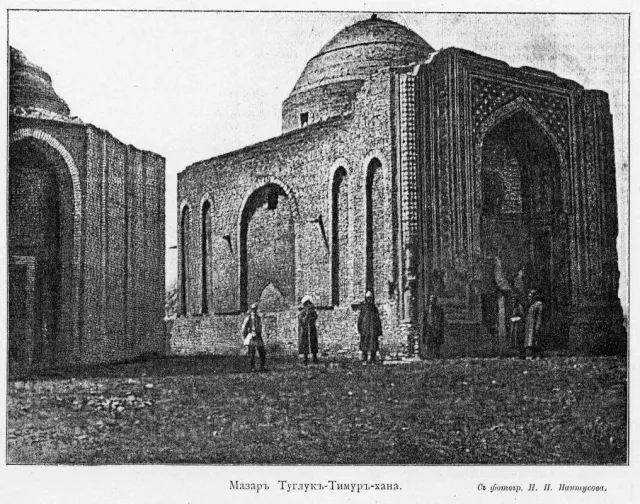
He is buried at Almaliq, the old Chagatai capital near today's Ghulja. Mirza Haidar saw the tomb in the 16th century and admired its tall, decorated dome; he remembered an inscription in the plaster calling the building 'the work of a master-weaver' from Iraq, and a date of 'seven hundred and sixty and odd'. The mausoleum still stands in Huocheng county; Millward photographed it in 1990.
Sources: Mirza Muhammad Haidar Dughlat, The Tarikh-i-Rashidi: A History of the Moghuls of Central Asia, tr. E. Denison Ross, ed. N. Elias (London, 1895) · Mehmet Emin Buğra, Şarkî Türkistan Tarihi (1940), in Abdullah Oğuz, Şarkî Türkistan Tarihi: Metin Tenkidi, Türkiye Türkçesi ve İnceleme, MA thesis, İstanbul Üniversitesi (2020) · James A. Millward, Eurasian Crossroads: A History of Xinjiang (London: Hurst, 2007)
Sources (3)
- Mirza Muhammad Haidar Dughlat, The Tarikh-i-Rashidi: A History of the Moghuls of Central Asia, tr. E. Denison Ross, ed. N. Elias (London, 1895) · public domain
- Mehmet Emin Buğra, Şarkî Türkistan Tarihi (1940), in Abdullah Oğuz, Şarkî Türkistan Tarihi: Metin Tenkidi, Türkiye Türkçesi ve İnceleme, MA thesis, İstanbul Üniversitesi (2020) · cited only
- James A. Millward, Eurasian Crossroads: A History of Xinjiang (London: Hurst, 2007) · cited only