ruler · ? – 1877
Yaqub Beg
ياقۇپبەگ
The officer from Kokand who built his own state in the Tarim Basin, Yettishar, and made Kashgar a capital that London, St Petersburg and Istanbul dealt with: he signed a trade treaty with Russia in 1872, received a British mission of 350 people in 1873–74 and accepted the Ottoman sultan as his overlord.
He came to Kashgar in 1865 and within a few years ruled most of the basin; he died suddenly at Korla in 1877 as the Qing armies returned.
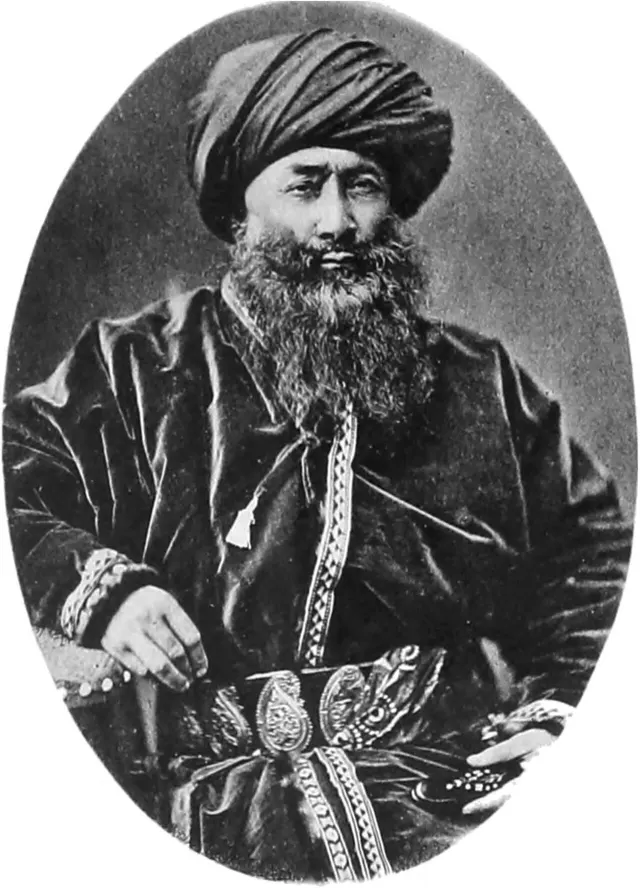

Life and works
- 1865foundingYaqub Beg comes to KashgarThe rise of Yettishar, a state built by an officer from Kokand.
- 1877fallYaqub Beg dies and the Qing returnThe end of Yaqub Beg's state.
- 1877DiedKorla
How did Yaqub Beg get the world's attention?
By playing the great empires against each other. Russia had just conquered Transoxiana, including Kokand, and the Qing were expected to return; Yaqub Beg's answer was diplomacy on a scale no Central Asian ruler had tried. He signed a trade treaty with Russia in 1872. He courted the British, who hoped for a buffer state against Russia: he hosted a mission of 350 people under T. D. Forsyth in 1873–74, signed a commercial treaty, and posted an envoy to London. And he accepted the Ottoman sultan as his overlord, which brought him cannon, thousands of rifles and Ottoman officers to drill his army.
Visitors found a court that mixed Central Asian and European ceremony. In the Qing-built fortress at Kashgar, envoys were led by silk-robed attendants past his guard to a pavilion with potted poplars, served tea, fruit and bread, and once honoured with a fifteen-gun salute. Buğra, no admirer, grants that his unification of the country gave it strength and standing, and that great powers recognised its independence. Millward's verdict: under Yaqub Beg, Xinjiang for the first time became visible to the whole world.
Sources: James A. Millward, Eurasian Crossroads: A History of Xinjiang (London: Hurst, 2007) · Mehmet Emin Buğra, Şarkî Türkistan Tarihi (1940), in Abdullah Oğuz, Şarkî Türkistan Tarihi: Metin Tenkidi, Türkiye Türkçesi ve İnceleme, MA thesis, İstanbul Üniversitesi (2020) · T. D. Forsyth, Report of a Mission to Yarkund in 1873 (Calcutta, 1875)
What was his rule like for the people of the Tarim?
Hard, and on this two very different historians agree. Millward calls it 'for the most part an occupation regime': most of his governors and the core of his army were men from Kokand, with Kashmiris, Afghans, Kirghiz, Tungans and others, and the local religious leaders who had risen in 1864 were removed. Officials had no salaries and lived off the people; an army of some 40,000 had to be fed in the oases; trade with China had stopped and even the jade mines were abandoned. Religious police flogged women who were not properly veiled and men without turbans. An old man told a British visitor of the Qing: 'I hate them. But they were not bad rulers. We had everything then. There is nothing now.'
Buğra, writing as a nationalist in 1940, is harsher still. Yaqub Beg, he says, had no council and no vizier, treated the country as a colony and its people as captives, and fought no foreign enemy, only the local mujahids. Had he won the people's hearts, Buğra writes, he would be remembered as the hero of a nation's independence; instead he built a state on a rotten foundation. Millward too warns against reading him as a Uyghur freedom fighter: he was an outsider from Kokand who imposed his rule on the Tarim.
Sources: James A. Millward, Eurasian Crossroads: A History of Xinjiang (London: Hurst, 2007) · Mehmet Emin Buğra, Şarkî Türkistan Tarihi (1940), in Abdullah Oğuz, Şarkî Türkistan Tarihi: Metin Tenkidi, Türkiye Türkçesi ve İnceleme, MA thesis, İstanbul Üniversitesi (2020)
Where did he come from, and how did he die?
He came from Kokand, and much of his early life is legend: that he worked as a dancing boy in teahouses, or that he led a heroic defence of Aq Masjid against the Russians. In 1865 the ruler of Kokand, Alim Quli, sent him as the military officer beside a khoja, Buzurg, to join the Kirghiz besieging Kashgar after the risings of 1864. Within months he had pushed Buzurg aside, and by the summer of 1871 he held the whole south from Kashgar to Turfan; the Ili valley was taken by Russia that year.
He died at Korla in late May 1877, as the Qing army under Zuo Zongtang's general Liu Jintang came west; he had ordered his troops not to engage, still hoping that talks in London would bring a settlement. How he died is disputed. Buğra writes that Niyaz Beg of Khotan had him poisoned; Qing sources say he took his own life, which Millward calls the usual imperial spin; Kim Hodong and Millward think a stroke likely. The site shows Buğra's view first (ADR 0010), the others beside it. Within months his state was gone.
Sources: James A. Millward, Eurasian Crossroads: A History of Xinjiang (London: Hurst, 2007) · Mehmet Emin Buğra, Şarkî Türkistan Tarihi (1940), in Abdullah Oğuz, Şarkî Türkistan Tarihi: Metin Tenkidi, Türkiye Türkçesi ve İnceleme, MA thesis, İstanbul Üniversitesi (2020)
Sources (4)
- James A. Millward, Eurasian Crossroads: A History of Xinjiang (London: Hurst, 2007) · cited only
- Mehmet Emin Buğra, Şarkî Türkistan Tarihi (1940), in Abdullah Oğuz, Şarkî Türkistan Tarihi: Metin Tenkidi, Türkiye Türkçesi ve İnceleme, MA thesis, İstanbul Üniversitesi (2020) · cited only
- T. D. Forsyth, Report of a Mission to Yarkund in 1873 (Calcutta, 1875) · public domain
- Pavel Lurje, “Kashgar”, Encyclopaedia Iranica (2012) · cited only
Years confirmed by two sources.