dynasty · ≈ 1697 – 1912
Qing dynasty
چىڭ سۇلالىسى
The Manchu empire that destroyed the Dzungars, conquered the region in 1759, and in 1884 made it a province and gave it the name 'Xinjiang', 'new frontier'.
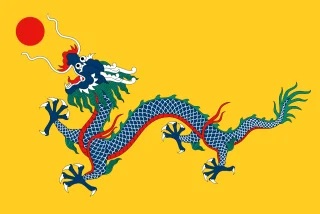
How did the Qing govern the region?
As an Inner Asian empire, not as a Chinese province, for its first century. After destroying the Dzungars and taking the Tarim in 1759, the Qing ruled through Manchu and Mongol officials, the ambans, under a military governor in the Ili valley. Below them, each people was governed its own way: nomads under hereditary chiefs (jasaks), the princes of Kumul and Turfan in their own domains, and the oasis cities through some 300 Muslim officials, the begs, who handled taxes, irrigation, police and courts. Uyghur and foreign merchants paid no local commercial tax. Millward judges that for its first hundred years Qing rule in the Tarim was stable, and given the growing farms, trade and population, perhaps even good.
Buğra remembers the conquest as the start of a new Chinese occupation after a thousand years of freedom. He describes mosques, minarets and baths pulled down for their timber and stone, homes taken for barracks, rich men killed on invented charges and their goods seized, a yearly poll tax, levies on land, livestock and pasture, sales taxed at 30 to 50 per cent, and a travel pass needed for a single day's journey.
Sources: James A. Millward, Eurasian Crossroads: A History of Xinjiang (London: Hurst, 2007) · Mehmet Emin Buğra, Şarkî Türkistan Tarihi (1940), in Abdullah Oğuz, Şarkî Türkistan Tarihi: Metin Tenkidi, Türkiye Türkçesi ve İnceleme, MA thesis, İstanbul Üniversitesi (2020)
How did Xinjiang become a province?
Out of the ruins of the old system. After the risings of 1864 and the years of Yaqub Beg, the Qing armies that came back in 1876–78 found the old order gone: many begs dead or stripped of their estates, the Manchu and Mongol garrisons wiped out, the Manchu citadel of Urumchi razed without a trace. The court had argued over whether to spend its money on ships for the coast or on armies for the far west; Zuo Zongtang won with the claim that losing Xinjiang would endanger Mongolia, and so Beijing itself.
In 1884 the court made Xinjiang, 'the new frontier', a province, with counties and prefectures under Confucian-trained magistrates in place of begs, princes and Mongol chiefs; Liu Jintang became its first governor. Millward stresses that this was not 'China annexing' a protectorate but a change in how the Qing empire governed its own periphery. It carried an aim beyond saving money: planners expected that schools in the classics and Chinese settlers on new farmland would make the region more like China proper.
Sources: James A. Millward, Eurasian Crossroads: A History of Xinjiang (London: Hurst, 2007)
Events
- 1696The Battle of Jao Modobattle · Tuul River
- 1755The Qing take Dzungariafall · Ghulja
- ≈ 1755The destruction of the Dzungarsfall · Ghulja
- 1759The Qing conquer Kashgariafall · Kashgar
- 1765The Ush Turfan uprisinguprising · Aksu
- ≈ 1771The Torghuts come home from the Volgamigration · Bayingolin Mongol Autonomous Prefecture
- 1826Jahangir Khoja takes Kashgaruprising · Kashgar
- 1864The rebellions of 1864uprising · Kucha
- 1865Yaqub Beg comes to Kashgarfounding · Kashgar
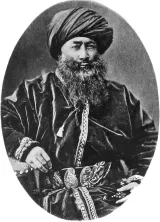
- 1877Yaqub Beg dies and the Qing returnfall · Turfan
- 1883The first new-method school in Artushfounding · Artush · disputed
- 1884Xinjiang becomes a provincefounding · Ürümqi
- ≈ 1902The first German Turfan expeditionexpedition · Qocho
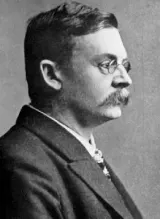
- 1904Le Coq arrives in Turfanexpedition · Turfan
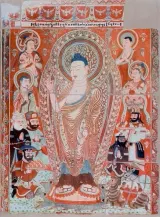
- ≈ 1904The Bezeklik murals are taken to Berlinevent · Bezeklik Thousand Buddha Caves
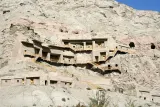
- ≈ 1905The third German expeditionexpedition · Kashgar
- ≈ 1907Kumul's peasants against their princeuprising · Yizhou District
- 1912Yang Zengxin takes powerevent · Ürümqi
People of this time
Sources (2)
- James A. Millward, Eurasian Crossroads: A History of Xinjiang (London: Hurst, 2007) · cited only
- Mehmet Emin Buğra, Şarkî Türkistan Tarihi (1940), in Abdullah Oğuz, Şarkî Türkistan Tarihi: Metin Tenkidi, Türkiye Türkçesi ve İnceleme, MA thesis, İstanbul Üniversitesi (2020) · cited only
Years are approximate; they will be checked against a second source.
Flag of Qing dynasty: Original: zh:清朝政府 Vector: Sodacan · Public domain · Wikimedia Commons
