republic · ≈ 1933 – 1934
East Turkistan Islamic Republic
شەرقىي تۈركىستان ئىسلام جۇمھۇرىيىتى
The first East Turkistan republic, proclaimed at Kashgar in November 1933 and overthrown by Tungan troops a few months later, in 1934. It took in the oases of Khotan, Yarkand and Kashgar; Khoja Niyaz was its president and Sabit Damolla its prime minister.
It is also called the Turkish Islamic Republic of East Turkestan.
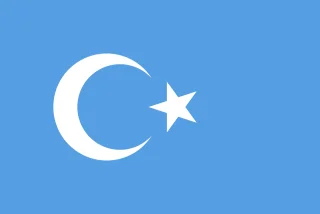
How was the republic of 1933 founded?
Out of several risings that met at Kashgar. In early 1933 gold miners rose in Khotan, and Mehmet Emin Buğra and his brothers, who had long been organising in secret, set up an Islamic government there and styled themselves emirs. Buğra's brother Abdullah and Sabit Damolla, a publisher from Artush, went to Kashgar, where the city had changed hands between Kirghiz, Uyghur and Tungan forces; there Sabit gathered educators and merchants who had led the reform schools of the 1910s–20s. On 12 November 1933 they proclaimed the East Turkistan Republic.
The day was staged like a modern national festival: some 7,000 troops and 13,000 people on the Tümen river, blue banners reading 'East Turkistan Islamic Republic', a 41-gun salute, students singing 'Our flag is a blue flag, our horde is a golden horde', then speeches from the roof and minaret of the Id Kah mosque. The constitution put the state under the sharia, called it a democratic republic and promised schools, libraries, foreign study and hospitals. Khoja Niyaz, leader of the Kumul rising, was named president for life in his absence; Sabit Damolla was prime minister.
Sources: James A. Millward, Eurasian Crossroads: A History of Xinjiang (London: Hurst, 2007)
Why did it last only a few months?
Because it had enemies on every side and no friends abroad. Turkey sent sympathy but no help; the Soviet Union opposed an independent Turkic or Islamic state on its border; Britain kept contacts but gave no material support; Nanjing denied its legitimacy and went on recognising the Tungan generals and Sheng Shicai. Food prices in Kashgar doubled between October and December 1933. Buğra, who led the Khotan government, blames division within: in his account suspect newcomers among Sabit Damolla's advisers set Uzbek, Kirghiz and Kashgari commanders against each other, and Khoja Niyaz, whom he came to see as an ignorant man ready to deal with any side, failed the cause.
In early 1934 the Tungan troops of Ma Zhongying, driven south by the Soviets, took Kashgar and massacred its people (one source counts 4,500 dead). Khoja Niyaz made his peace with Sheng and handed Sabit Damolla over to Soviet forces at Aksu. In June the Tungans broke Khotan's defences at Zava; Buğra's two brothers were killed, and with about fifty men left he crossed the mountains to India.
Sources: James A. Millward, Eurasian Crossroads: A History of Xinjiang (London: Hurst, 2007) · Mehmet Emin Buğra, Şarkî Türkistan Tarihi (1940), in Abdullah Oğuz, Şarkî Türkistan Tarihi: Metin Tenkidi, Türkiye Türkçesi ve İnceleme, MA thesis, İstanbul Üniversitesi (2020)
Events
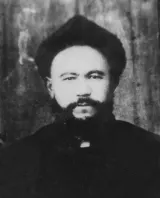
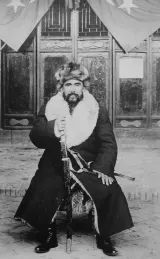
People of this time
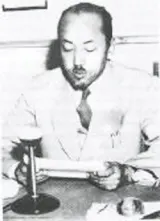
Sources (2)
- James A. Millward, Eurasian Crossroads: A History of Xinjiang (London: Hurst, 2007) · cited only
- Mehmet Emin Buğra, Şarkî Türkistan Tarihi (1940), in Abdullah Oğuz, Şarkî Türkistan Tarihi: Metin Tenkidi, Türkiye Türkçesi ve İnceleme, MA thesis, İstanbul Üniversitesi (2020) · cited only
Years are approximate; they will be checked against a second source.
Flag of East Turkistan Islamic Republic: User:Tarkan · Public domain · Wikimedia Commons
