regime · ≈ 1934 – 1937
Tungan 36th Division ("Tunganistan")
تۇڭگان 36-دىۋىزىيەسى (تۇڭگانىستان)
Three years in which the Tungan general Ma Zhongying's 36th Division, having overthrown the Kashgar republic in 1934, held the Khotan and Keriya oases as its own domain, the time called 'Tunganistan' (1934–1937).
How did 'Tunganistan' come about?
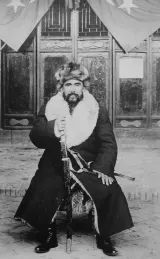
As the price of the 1934 settlement. In July 1934, after overthrowing the Kashgar republic and destroying Khotan's government, the Tungan general Ma Zhongying sent the bulk of his 36th Division to Khotan and himself rode across the border into the Soviet Union with 280 men, supposedly for military training; after 1937 nothing more was heard of him. His half-brother Ma Hushan took command and, after a truce with Sheng Shicai, held the oases of the southern Tarim, from Khotan to Keriya, Charchan and Charkhlik, as his own domain.
The name 'Tunganistan' was given to it later by the scholar Walther Heissig. Forbes stresses that it was not a Muslim separatist state: Ma Hushan, called padishah by his Turkic subjects, kept declaring loyalty to the Nationalist government in Nanjing, saw himself as the standard-bearer of Chinese nationalism against the 'Soviet puppet' in Urumchi, and posted anti-Japanese slogans in the oases. Forbes calls it a Tungan warlord enclave transplanted from Gansu, a bastion of Chinese colonialism rather than of Muslim separatism.
Sources: James A. Millward, Eurasian Crossroads: A History of Xinjiang (London: Hurst, 2007) · Andrew D. W. Forbes, Warlords and Muslims in Chinese Central Asia (1986)
What was life like under it?
Hard. The British vice-consul Gillett, who visited in 1937, first thought the Tungans' young, military government might be capable of administration: street names in Chinese and Turki, lamps at night, refuse bins. After two months he changed his mind: the whole aim of the government was to supply the army with money and goods, 'while the needs of the people are entirely disregarded. Education is utterly neglected, and taxation is cruelly heavy.' The traveller Filchner reported that the oasis of Charchan was assessed at 1,000 lot of gold, every inhabitant owing a contribution in gold, and that a third of its people fled. Peter Fleming saw the Tungans at Keriya commandeer 6,000 eggs, 300 measures of oil and 140 bricks of tea in a day and feed them to their horses.
An army of at least 10,000 men lived off a string of poor oases; press-gangs took the young men, silk weaving almost stopped, the jade mines closed, and even Khotan's carpets turned to shoddy Chinese designs. It ended in 1937, when Sheng Shicai, with Soviet troops, crushed both the Uyghur rebels and the independent Tungans in the south and took control of the whole province.
Sources: Andrew D. W. Forbes, Warlords and Muslims in Chinese Central Asia (1986) · James A. Millward, Eurasian Crossroads: A History of Xinjiang (London: Hurst, 2007)
Events
People of this time
Sources (2)
- James A. Millward, Eurasian Crossroads: A History of Xinjiang (London: Hurst, 2007) · cited only
- Andrew D. W. Forbes, Warlords and Muslims in Chinese Central Asia (1986) · cited only
Years are approximate; they will be checked against a second source.