Stop 5 / 10 · building
The Kizil caves
Caves painted in an 'Indo-Iranian' style.
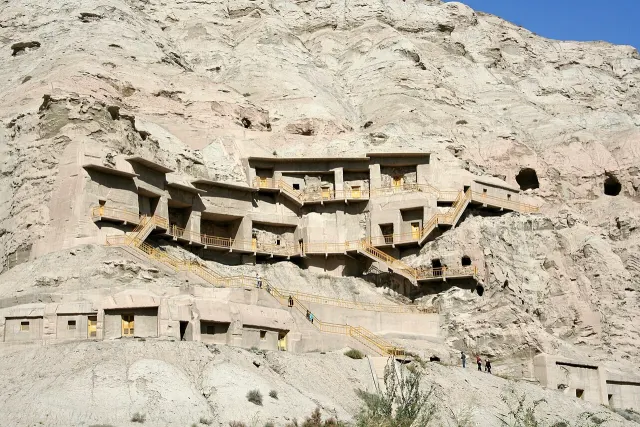
Buddhist caves whose wall paintings, cut off and carried to Berlin by German expeditions, show the wealth of Kucha in the 5th and 6th centuries in a style Grünwedel called 'Indo-Iranian'. They are cut into the cliffs along the Muzat river west of Kucha.

What do the Kizil caves tell us about Kucha?
That it was rich, Buddhist and open to the west. Kucha was by far the most populous kingdom of the Tarim: the Book of Han counts 81,317 people against fewer than 20,000 in Khotan or Kashgar. It lived on copper, iron and lead from the mountains to its north, on trade, and on wine: when a Chinese army entered in 384 it found huge wine cellars in people's houses. The hundreds of painted caves along the Muzat river, from the 5th and 6th centuries above all, show that wealth turned into faith, in a style Grünwedel called 'Indo-Iranian'; one cave has an Iranian motif he traced and published in 1912. Sanskrit manuscripts found at Kizil name four of the early kings of Kucha, and Kucha's own language, now called Tocharian B, was the kingdom's official language around the 7th century.
Sources: Chao-jung Ching, “Kucha”, Encyclopaedia Iranica (2021)
Where are the wall paintings now?
Many of the best are in Berlin. The German expeditions of 1905–1907 and after cut large sections from the cave walls and shipped them to the Museum für Völkerkunde, today part of the Museum of Asian Art; others were taken by Russian and Japanese expeditions. In the caves, many walls now show the rectangular scars where the paintings were removed.
Sources: Werner Sundermann, “Turfan Expeditions”, Encyclopaedia Iranica (2004) · Tachibana Zuichō's work for the Ōtani expeditions; Hopkirk, Foreign Devils on the Silk Road (1980)
Sources (3)
- Chao-jung Ching, “Kucha”, Encyclopaedia Iranica (2021) · cited only
- Werner Sundermann, “Turfan Expeditions”, Encyclopaedia Iranica (2004) · cited only
- Tachibana Zuichō's work for the Ōtani expeditions; Hopkirk, Foreign Devils on the Silk Road (1980) · cited only