Stop 5 / 9 · monk · 602 – 664
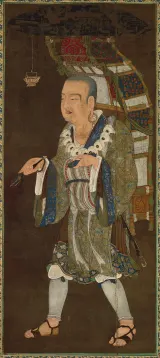
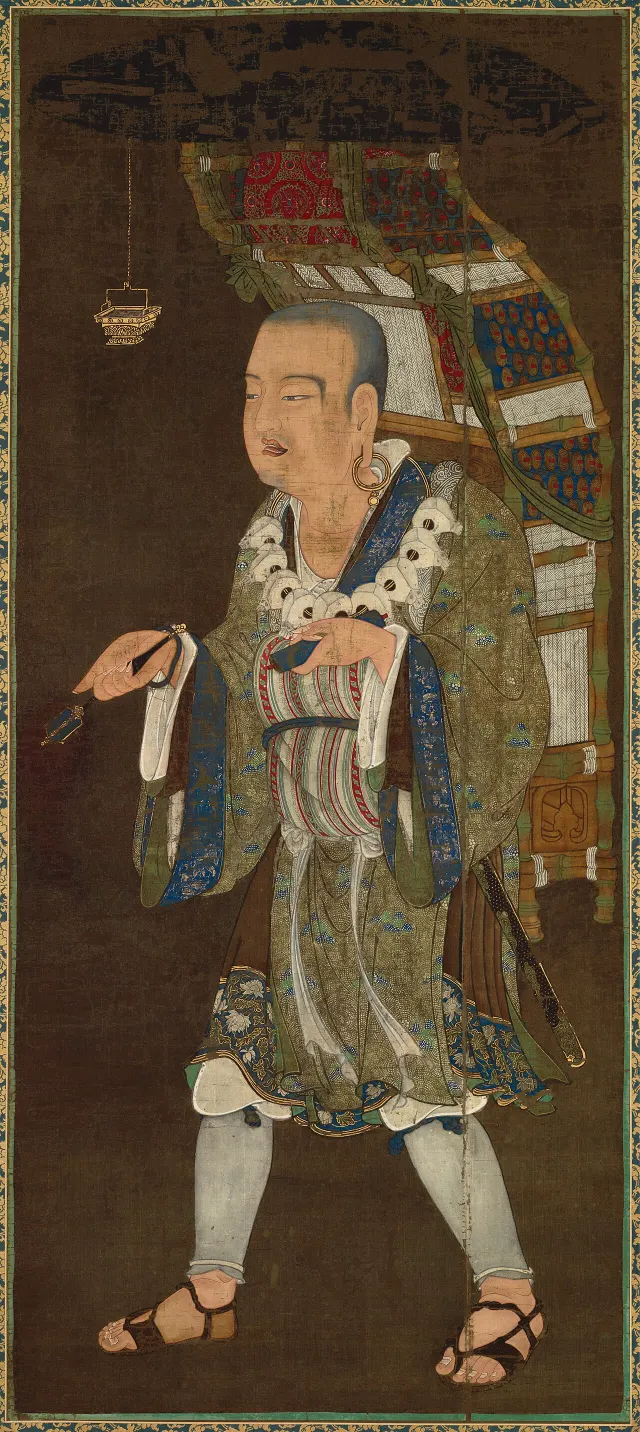
Xuanzang
A monk who set out alone for India.
The pilgrim whose travel record is one of the most important eyewitness sources on the Tarim kingdoms of the 7th century: he passed through Gaochang (today Karahoja, near Turfan), Kucha and other oases on his way to India around 629, and came home by way of Khotan in 644. A Chinese Buddhist monk and translator.

What did he leave us about the Tarim kingdoms?
Eyewitness pages from the moment before the Tang conquest. On his way out, around 629, the king of Gaochang, Qu Wentai, met him by torchlight and tried to keep him for life; Xuanzang sat three days without food or drink until the king let him go, swore brotherhood with him, and gave him thirty horses, twenty-four servants and letters to twenty-four rulers in the west. At Kucha he noted gold, silver, copper, lead and tin, grapes, pomegranates, millet, wheat and rice. Coming home by Khotan in 644, he wrote down the kingdom's legends: the founding by a banished Indian prince fed by a breast rising from the earth, and the princess who smuggled silkworms in her headdress, the scene later found painted on a panel at Dandan Oilik.
He had promised Qu Wentai to stay three years on his return, but by then Gaochang no longer existed: the Tang had taken it in 640. His travel record and his biography by his disciple Hui Li are among the most important sources on the Tarim in the 7th century.
Sources: Hui Li, The Life of Hiuen-Tsiang, tr. Samuel Beal (London, 1888; new ed. 1911) · Chao-jung Ching, “Kucha”, Encyclopaedia Iranica (2021) · Hiroshi Kumamoto, “Khotan ii. History in the Pre-Islamic Period”, Encyclopaedia Iranica (2009) · Stein, Ancient Khotan (1907)
Sources (5)
- Hui Li, The Life of Hiuen-Tsiang, tr. Samuel Beal (London, 1888; new ed. 1911) · public domain
- Chao-jung Ching, “Kucha”, Encyclopaedia Iranica (2021) · cited only
- Hiroshi Kumamoto, “Khotan ii. History in the Pre-Islamic Period”, Encyclopaedia Iranica (2009) · cited only
- Stein, Ancient Khotan (1907) · public domain
- Wikidata · cited only