Stop 11 / 12 · ruler · ? – 734
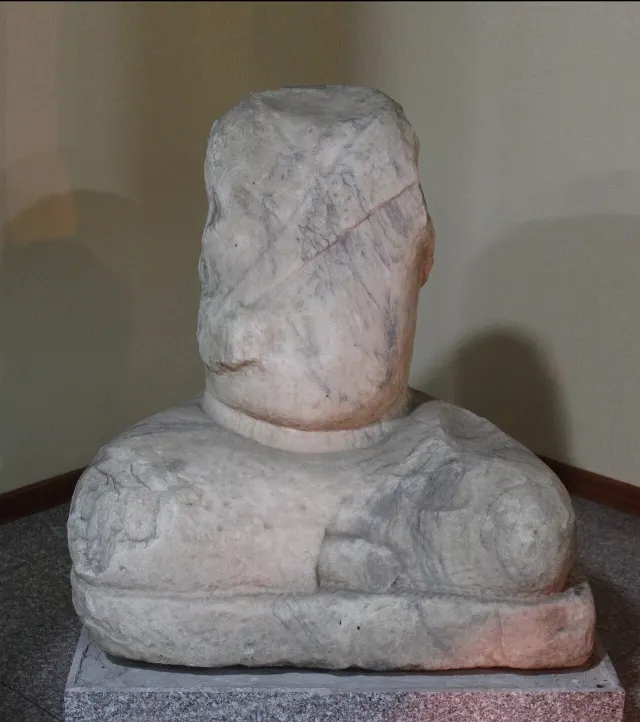
Bilge Qaghan
The poisoned khagan.
The khagan in whose voice the Orkhon inscriptions speak, who with his brother Kül Tegin and his adviser Tonyukuk made peace and trade with the Tang, and who was poisoned by his own minister. He ruled the second Türk khaganate from 716 to 734; before he died he had the poisoner, Buyruq Chor, and his faction killed.

Why did he carve his history in stone?
So that the Türks would not forget how they had lost their state once and how they won it back. 'Everything I had to say I have written on this everlasting stone,' he tells his lords and people; 'look at it and learn.' His message: unity, staying in the Ötüken (today Khangai Mountains) land, trading with China but not moving into its shadow, because its sweet words and soft silk had cost the Türks fifty years of servitude. He also boasts of what he did as khagan: 'I raised up the people who had nothing and were poor; I made the poor rich and the few many.' His own stone stands near his brother's, and he speaks in the first person on both.
His rule (716–734) leaned on two men: his younger brother Kül Tegin, who led the army, and the old adviser Tonyukuk, who talked him out of building walled towns and temples. With them he made peace and trade with the Tang. In the end his minister Buyruq Chor poisoned him; before he died he had the poisoner and his faction killed. His death year is disputed: 734 by most sources, 732 by some.
Sources: Vilhelm Thomsen, Inscriptions de l'Orkhon déchiffrées (Helsingfors, 1896) · Jiu Tangshu (Old History of the Tang), chapter 194A: the Türks, Chinese original on Wikisource · Mehmet Emin Buğra, Şarkî Türkistan Tarihi (1940), in Abdullah Oğuz, Şarkî Türkistan Tarihi: Metin Tenkidi, Türkiye Türkçesi ve İnceleme, MA thesis, İstanbul Üniversitesi (2020)
Sources (3)
- Vilhelm Thomsen, Inscriptions de l'Orkhon déchiffrées (Helsingfors, 1896) · public domain
- Jiu Tangshu (Old History of the Tang), chapter 194A: the Türks, Chinese original on Wikisource · public domain
- Mehmet Emin Buğra, Şarkî Türkistan Tarihi (1940), in Abdullah Oğuz, Şarkî Türkistan Tarihi: Metin Tenkidi, Türkiye Türkçesi ve İnceleme, MA thesis, İstanbul Üniversitesi (2020) · cited only