Stop 10 / 12 · inscription
The Kül Tegin inscription
A stone that speaks in two languages.
The stone on which the Türks told their own history in their own words, and warned their people never again to fall under China's spell. It was raised in 732 for Kül Tegin in the Orkhon valley and speaks in Old Turkic runes in Bilge Qaghan's voice; one face carries a Chinese text composed by the Tang emperor Xuanzong. The Danish linguist Vilhelm Thomsen deciphered its script in 1893.
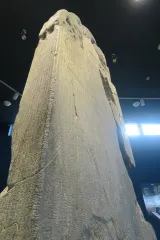
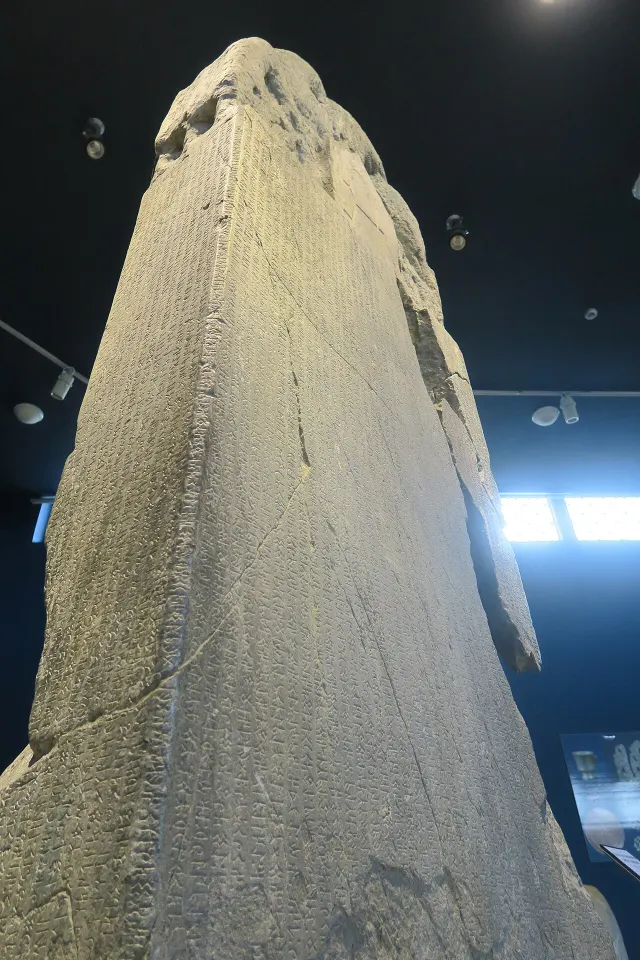

What does the stone say?
The Turkic text speaks in Bilge Qaghan's voice and begins at the creation: when the blue sky above and the dark earth below were made, the sons of men were made between them, and over them rose the ancestors Bumin Qaghan and Istemi Qaghan. They fought to the four corners of the world and settled the peoples from the Kadırkan forest in the east to the Iron Gate in the west.
Then comes the fall. Later khagans were unwise, factions plotted against each other, and the Chinese drew the Türks in with their charm. 'The sons of the nobles became slaves of the Chinese people, their pure daughters its servants.' The Türk lords gave up their Turkic titles, took Chinese ones and for fifty years gave their labour and strength to the Chinese emperor. The common people cried out: 'I was a people with a state of my own: where is my state now? I was a people with a khagan of my own: where is my khagan?' Bilge's father Ilterish rose with a handful of men; they became seventy, then seven hundred, and rebuilt the state. The rest of the text tells of the brothers' campaigns, with Kül Tegin at the head of the army.
Sources: Vilhelm Thomsen, Inscriptions de l'Orkhon déchiffrées (Helsingfors, 1896) · James A. Millward, Eurasian Crossroads: A History of Xinjiang (London: Hurst, 2007)
What advice does it give the Türks?
The heart of the text is a warning. The Chinese, it says, give gold, silver and silk without trouble; their words are sweet and their riches soft, and with them they draw distant peoples near. Many who believed them and moved close to China died. 'If you go to that land, Türk people, you will die. But if you stay in the land of Ötüken and send caravans from there, you will keep an everlasting state.' Trade with the neighbour, yes; living in its shadow, no.
Bilge then says why he had the stone carved: 'Everything I had to say I have written on this everlasting stone. Look at it and learn, lords and people of the Türks.' He asked the Chinese emperor for stone-carvers, and the emperor sent his own court craftsmen. The runic text was written by a young prince of the family, Yollugh Tegin, who says he spent twenty days at the stone.
Sources: Vilhelm Thomsen, Inscriptions de l'Orkhon déchiffrées (Helsingfors, 1896) · James A. Millward, Eurasian Crossroads: A History of Xinjiang (London: Hurst, 2007)
Why does it matter so much?
With the stones of Tonyukuk and Bilge Qaghan, it is among the oldest long texts in any Turkic language, and the first in which the Türks tell their own history in their own words, not through Chinese or Byzantine writers. The name 'Türk' stands on it as the name of a people and a state, and its repeated lines and direct speech to the listener show a prose made to be heard aloud.
For Uyghur history it matters twice. The Uyghur khagans who replaced the Türks in 744 raised stones in the same script, and Millward notes that the Uyghurs heeded the warning: they took their writing and their state religion from the Sogdians, not from the Tang. And it was this stone, with its Chinese face, that Vilhelm Thomsen worked from when he deciphered the runic script in 1893; his edition of 1896 is still the starting point for reading it.
Sources: Vilhelm Thomsen, Inscriptions de l'Orkhon déchiffrées (Helsingfors, 1896) · James A. Millward, Eurasian Crossroads: A History of Xinjiang (London: Hurst, 2007)
Sources (4)
- Vilhelm Thomsen, Inscriptions de l'Orkhon déchiffrées (Helsingfors, 1896) · public domain
- James A. Millward, Eurasian Crossroads: A History of Xinjiang (London: Hurst, 2007) · cited only
- Jiu Tangshu (Old History of the Tang), chapter 194A: the Türks, Chinese original on Wikisource · public domain
- Mehmet Emin Buğra, Şarkî Türkistan Tarihi (1940), in Abdullah Oğuz, Şarkî Türkistan Tarihi: Metin Tenkidi, Türkiye Türkçesi ve İnceleme, MA thesis, İstanbul Üniversitesi (2020) · cited only