Stop 9 / 12 · general · ≈ 683 – ≈ 731
Kül Tegin
The prince who refused the throne.
The prince who killed his rivals, put his elder brother Bilge on the throne and refused it himself, and whose memorial stone is the most famous of the Orkhon inscriptions. Son of Qutlugh Qaghan, he commanded Bilge Qaghan's army; the coup came after Qapaghan Qaghan's death in 716.

What kind of fighter was he?
His brother's stone answers battle by battle, naming the horses. In his thirty-first year, against the Chinese general Chacha Sengün, he charged on the grey horse of Tadik Chor, and it was killed; then on the grey Ishbara Yamatar, killed too; then on Kedimlig, a bay, and shot more than a hundred men with arrows. Against the Oghuz he rode his white Alp Shalchi again and again, and his brown Az Yaghiz; once he pierced two men. When the Oghuz attacked the khagan's camp, he rode out on his white horse Ögsiz, 'the orphan', pierced nine men and did not give up the camp. 'If Kül Tegin had not been there,' Bilge says, 'my mother the khatun, my sisters, my daughters-in-law would have become slaves, and many of you would have died.'
Buğra adds a western front: he identifies him with the Türk commander who in 706–709 fought the Arab general Qutayba ibn Muslim at Tirmiz and Bukhara, won twice and was wounded in a night attack. The inscription itself only says the brothers campaigned to the Iron Gate.
Sources: Vilhelm Thomsen, Inscriptions de l'Orkhon déchiffrées (Helsingfors, 1896) · Mehmet Emin Buğra, Şarkî Türkistan Tarihi (1940), in Abdullah Oğuz, Şarkî Türkistan Tarihi: Metin Tenkidi, Türkiye Türkçesi ve İnceleme, MA thesis, İstanbul Üniversitesi (2020)
What happened when he died?
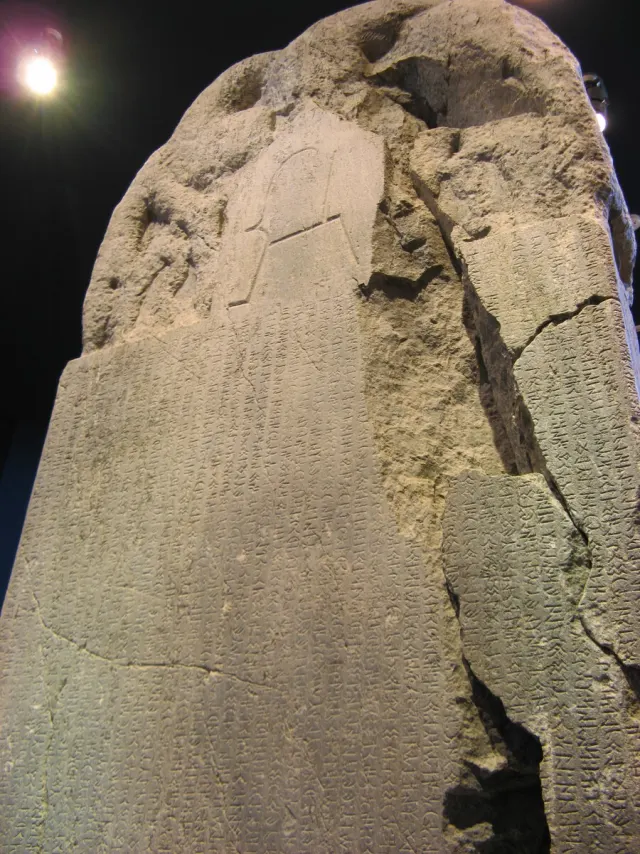
His brother grieved in words that still move readers: 'Though my eyes saw, it was as if they did not see; though my mind knew, it was as if it knew nothing. Heaven decides the time; the sons of men are all born to die.' Bilge asked the Tang emperor for stone-carvers, raised a hall, a statue and the inscribed stone for him in the Orkhon valley, and the emperor Xuanzong himself wrote the Chinese text on one face. That stone is the Kül Tegin inscription. He died in 731 by most accounts (some say 732).
Who he was by birth matters less than what he chose: after Qapaghan Qaghan's death in 716 he killed Qapaghan's sons, put his elder brother on the throne and refused it himself.
Sources: Vilhelm Thomsen, Inscriptions de l'Orkhon déchiffrées (Helsingfors, 1896) · Jiu Tangshu (Old History of the Tang), chapter 194A: the Türks, Chinese original on Wikisource
Sources (3)
- Vilhelm Thomsen, Inscriptions de l'Orkhon déchiffrées (Helsingfors, 1896) · public domain
- Mehmet Emin Buğra, Şarkî Türkistan Tarihi (1940), in Abdullah Oğuz, Şarkî Türkistan Tarihi: Metin Tenkidi, Türkiye Türkçesi ve İnceleme, MA thesis, İstanbul Üniversitesi (2020) · cited only
- Jiu Tangshu (Old History of the Tang), chapter 194A: the Türks, Chinese original on Wikisource · public domain