Stop 2 / 10 · wall painting
Bezeklik praṇidhi murals
Wall paintings no one can see any more.
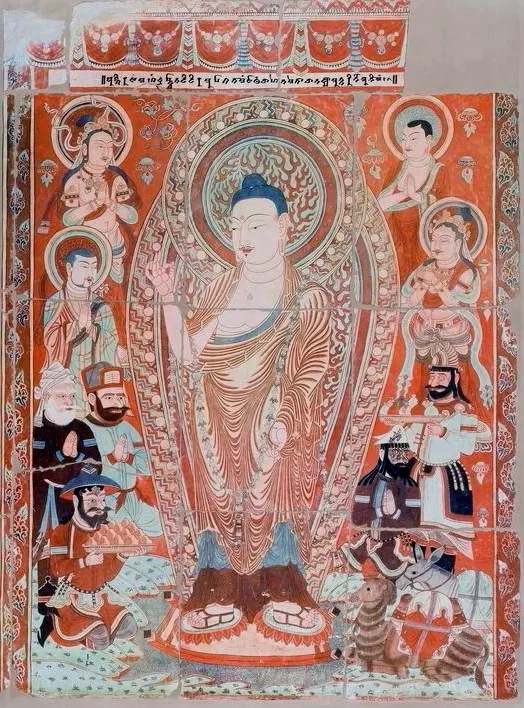
Some of the finest Buddhist paintings of the Silk Road, cut from the walls of Bezeklik's temple 9, carried to Berlin in 1904–1905 and destroyed there in an air raid in 1943; only photographs remain.

What do these paintings show?
Vows made in past lives. Each large panel (praṇidhi means 'vow') shows the future Buddha Shakyamuni, in one of his earlier lives, kneeling or offering gifts before a Buddha of a former age and vowing to become a Buddha himself; the Buddha stands in the middle, larger than everyone, with the donor and attendants around him. Painted in the Uyghur kingdom of Qocho (today Karahoja, near Turfan), they show how richly its Buddhist monasteries were endowed. The same cave temple also has portraits of Uyghur princes in their robes and tall headdresses; Millward reproduces one.
Sources: Werner Sundermann, “Turfan Expeditions”, Encyclopaedia Iranica (2004) · James A. Millward, Eurasian Crossroads: A History of Xinjiang (London: Hurst, 2007)
Why are they gone?
Because they were safe nowhere. Le Coq and Bartus sawed them off the walls of cave 9 during the second German expedition (1904–1905) and shipped them to Berlin, where they hung in the Museum für Völkerkunde as the pride of its Turfan collection. In an early air raid on Berlin in 1943 they were destroyed. No collection of Turfan antiquities suffered more from the Second World War. What remains are the photographs taken before 1943, some smaller fragments, and the bare walls at Bezeklik where they had hung.
Sources: Werner Sundermann, “Turfan Expeditions”, Encyclopaedia Iranica (2004)