Stop 3 / 10 · explorer · 1856 – 1935
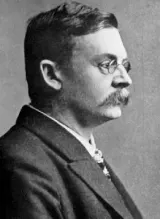
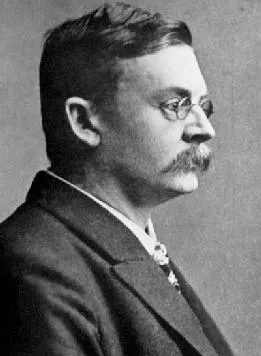
Albert Grünwedel
A Buddhist art scholar at the Berlin museum.
The scholar who studied Qocho (today Karahoja, near Turfan) and the Kizil caves for the German Turfan expeditions and named the 'Indo-Iranian' style of the Kizil paintings; his finds went to Berlin. He led the first and third expeditions (1902–1907).

How was he different from Le Coq?
He was a scholar of Buddhist art first and a collector second. Grünwedel led the first German expedition, which left Berlin on 11 August 1902 and worked at Qocho, Sengim, Bezeklik and Toyuq, and the third, the longest of all, from December 1905 to 6 July 1907, for which the Prussian state paid 140,000 marks. He drew and described the caves in detail and published them in two large reports; in his study of the Kizil caves near Kucha he named their painting style 'Indo-Iranian', a label still used. Hopkirk tells of his unease at removing whole walls, the method Le Coq and Bartus favoured.
Sources: Werner Sundermann, “Turfan Expeditions”, Encyclopaedia Iranica (2004) · Grünwedel, Bericht über archäologische Arbeiten in Idikutschari (1906) · Grünwedel, Altbuddhistische Kultstätten in Chinesisch-Turkistan (1912) · Tachibana Zuichō's work for the Ōtani expeditions; Hopkirk, Foreign Devils on the Silk Road (1980)
Sources (5)
- Werner Sundermann, “Turfan Expeditions”, Encyclopaedia Iranica (2004) · cited only
- Grünwedel, Bericht über archäologische Arbeiten in Idikutschari (1906) · public domain
- Grünwedel, Altbuddhistische Kultstätten in Chinesisch-Turkistan (1912) · public domain
- Tachibana Zuichō's work for the Ōtani expeditions; Hopkirk, Foreign Devils on the Silk Road (1980) · cited only
- Wikidata · cited only