Stop 4 / 10 · khanate · ≈ 840 – 1211
Karakhanid Khanate
The Karakhanids become vassals.
The first Turkic dynasty to accept Islam, and the age that produced the first great books in Turkic, Mahmud al-Kashgari's Diwan and Yusuf Khass Hajib's Kutadgu Bilig. Its khans spent the winter in Kashgar and the summer in Balasagun (today Burana, Kyrgyzstan), and also styled themselves 'Tamghaj Khan', 'khan of China'. It grew in the 9th century out of the Qarluq, Yaghma and other Turkic tribes; its turn to Islam began with Satuq Bughra Khan. From the 1130s it was a vassal of the Qara Khitay, and its last khans were gone early in the 13th century.

Why do the Karakhanids matter so much?
Because two things that define the Uyghurs today meet here. The name 'Uyghur' comes from the Uyghur khaganate and the kingdom of Qocho (today Karahoja, near Turfan); but the religion of Kashgar and the western Tarim came through the Karakhanids, the first Turkic dynasty to become Muslim. Millward puts it simply: the Uyghur state gave today's Uyghurs their name, the Karakhanids their religion.
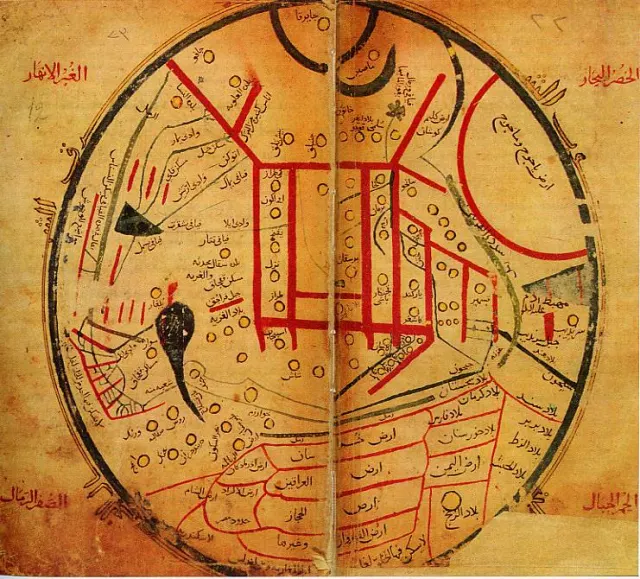
They also changed the wider Islamic world. In the 990s Harun Bughra Khan took Samarkand and Bukhara from the Samanids, and the Karakhanids became the first Turkic dynasty to rule in Islamic Central Asia, the first of several in the Islamic world. And in their lands Turkic became a language of books: Mahmud al-Kashgari wrote his Diwan, a dictionary of the Turkic dialects, and Yusuf Khass Hajib of Balasagun his Kutadgu Bilig. Buğra calls the Karakhanid age the golden age of East Turkistan and lists its madrasas, canals and silk weaving; Karakhanid gold and silver coins are kept today in museums in St Petersburg, Berlin and London.
Sources: James A. Millward, Eurasian Crossroads: A History of Xinjiang (London: Hurst, 2007) · Mehmet Emin Buğra, Şarkî Türkistan Tarihi (1940), in Abdullah Oğuz, Şarkî Türkistan Tarihi: Metin Tenkidi, Türkiye Türkçesi ve İnceleme, MA thesis, İstanbul Üniversitesi (2020)
How did the Karakhanids rule?
As a family, not as one throne. The royal house split into two branches: the senior khans took the title Arslan, 'lion', the junior Bughra, 'bull camel'. Each khan had his own lands, and princes of the house governed provinces as ilig khans. Islamic writers called the whole house simply 'the khaqanate'. The khans also called themselves 'Tamghaj Khan', 'khan of China', a claim to the old prestige of the steppe empires, whose sacred centre around Balasagun on the Chu river they now held.
Buğra describes two capitals: the khans wintered in Kashgar and spent the summer in Balasagun, but Kashgar was the true capital, called Ordukand, 'the city of the court'. The family system was a strength and a weakness: it held vast lands together for two centuries, but it also split them. By the mid-11th century there were an eastern and a western khanate, which fought each other and their neighbours.
Sources: James A. Millward, Eurasian Crossroads: A History of Xinjiang (London: Hurst, 2007) · Mehmet Emin Buğra, Şarkî Türkistan Tarihi (1940), in Abdullah Oğuz, Şarkî Türkistan Tarihi: Metin Tenkidi, Türkiye Türkçesi ve İnceleme, MA thesis, İstanbul Üniversitesi (2020)
How did the Karakhanids end?
Slowly, and the sources do not agree on the date. In the 1130s the Qara Khitay, a people from north China led by Yelü Dashi, took Balasagun and Kashgar. Buğra counts this as the end: in 530 of the Hijra (1136), he writes, the gurkhan took all of East Turkistan and destroyed the Karakhanid state, after 280 years. But the Qara Khitay ruled with a light hand: Millward stresses that the Karakhanid khans still reigned in Kashgar and Khotan as vassals, paying tribute and keeping their own armies.
The last of them fell in the troubles before the Mongols. The khan of Kashgar rose against the gurkhan early in the 13th century and was imprisoned; the usurper Küchlük then starved Kashgar into surrender by raiding it at harvest time three years running (1211–13). In the west the last khan, Sultan Osman of Samarkand, was killed by the Khwarazm Shah: in 1212 according to Biran's article in Encyclopaedia Iranica, in 1222–23 according to Buğra. The dispute below sets the views side by side.
Sources: Mehmet Emin Buğra, Şarkî Türkistan Tarihi (1940), in Abdullah Oğuz, Şarkî Türkistan Tarihi: Metin Tenkidi, Türkiye Türkçesi ve İnceleme, MA thesis, İstanbul Üniversitesi (2020) · James A. Millward, Eurasian Crossroads: A History of Xinjiang (London: Hurst, 2007) · Michal Biran, “Qarakhanids”, Encyclopaedia Iranica (2004)
Sources (3)
- James A. Millward, Eurasian Crossroads: A History of Xinjiang (London: Hurst, 2007) · cited only
- Mehmet Emin Buğra, Şarkî Türkistan Tarihi (1940), in Abdullah Oğuz, Şarkî Türkistan Tarihi: Metin Tenkidi, Türkiye Türkçesi ve İnceleme, MA thesis, İstanbul Üniversitesi (2020) · cited only
- Michal Biran, “Qarakhanids”, Encyclopaedia Iranica (2004) · cited only