manuscript · 1074
Dīwān Lughāt al-Turk
تۈركىي تىللار دىۋانى
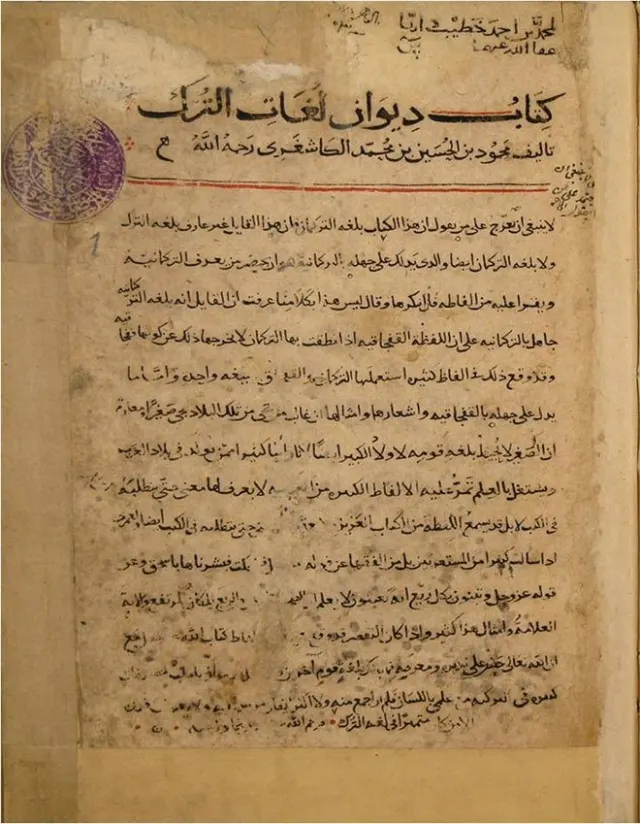
The first great book about the Turkic languages: a dictionary, an atlas, a collection of 764 lines of verse and a guide to the Turkic peoples of the 11th century in one.
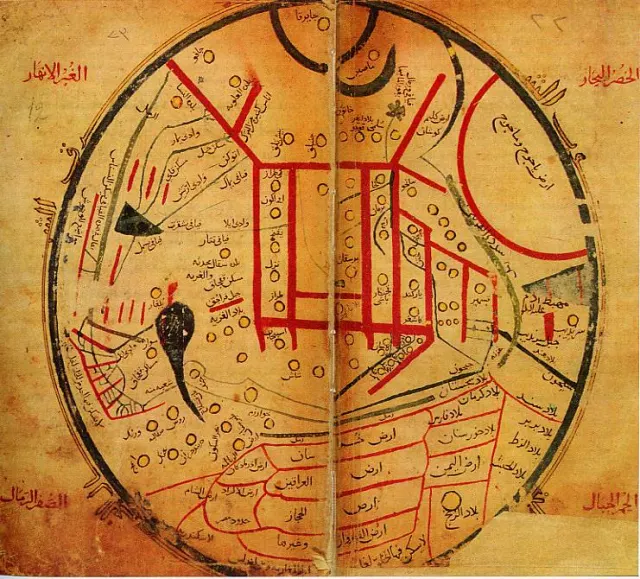
Mahmud al-Kashgari compiled it in Baghdad for the Abbasid caliph, explaining Turkic words in Arabic; it includes a round map of the world with the Turkic lands at its centre. A single copy, made in Damascus in 1266, survives.


What is inside it?
Far more than word lists. Mahmud wrote down Turkic words and explained them in Arabic, and for many words he gave an example: a line of verse, a proverb, a saying he had heard. Taken together these make an anthology of 764 lines of poetry, much of which survives nowhere else. Around the words he described the Turkic peoples, where each lived, how each spoke and how their speech differed; he retold legends and history; and he drew a round map of the world with the Turkic lands in the middle. Its modern editors call it at once a geography, a history, an ethnography and a book of poems.
The words themselves are a picture of the 11th century: names for kin and ranks, food and drink, weapons, horses and their gear, stars, seasons and games. A reader can still find there what a Karakhanid household ate, how a nomad counted his herd or what a song for a wedding sounded like.
Sources: Mehmet Emin Buğra, Şarkî Türkistan Tarihi (1940), in Abdullah Oğuz, Şarkî Türkistan Tarihi: Metin Tenkidi, Türkiye Türkçesi ve İnceleme, MA thesis, İstanbul Üniversitesi (2020) · James A. Millward, Eurasian Crossroads: A History of Xinjiang (London: Hurst, 2007)
Why was it written, and why does it matter?
Mahmud presented it to the Abbasid caliph al-Muqtadi in Baghdad (Oğuz gives 1074 or 1077). Buğra explains why it explains Turkic in Arabic: most of the caliph's statesmen, soldiers and officials were Turks, so the Arabs badly needed to learn Turkic. The Turkic Seljuks had just taken the caliphate under their protection. Mahmud brought the refined methods of Arabic dictionary-making to a language the Islamic world had looked down on as the speech of steppe barbarians.
He was proud of it. Though he knew Arabic and Persian well, he called the speech of the Uyghurs and the Karakhanids the most elegant and the purest of the Turkic dialects, because it had not mixed with Persian. That is why Uyghurs today count him among their great ancestors, and why every study of the early Turkic languages starts from his book.
Sources: Mehmet Emin Buğra, Şarkî Türkistan Tarihi (1940), in Abdullah Oğuz, Şarkî Türkistan Tarihi: Metin Tenkidi, Türkiye Türkçesi ve İnceleme, MA thesis, İstanbul Üniversitesi (2020) · James A. Millward, Eurasian Crossroads: A History of Xinjiang (London: Hurst, 2007)
How did it survive?
By a thread. Only one copy is known, made in Damascus in 1266 by Muhammad ibn Abi Bakr, almost two centuries after Mahmud. It surfaced in Istanbul in the last years of the Ottoman Empire, when a woman from the family of a former finance minister, Ahmed Nazif Pasha, brought it to a bookseller to sell, and the scholar Ali Emiri recognised it. Kilisli Rifat printed it in three volumes from Ali Emiri's library, and Besim Atalay made the first Turkish translation with an index. Mehmet Emin Buğra, writing his history of East Turkistan in 1940, cited it more than any other book.
Sources: Mehmet Emin Buğra, Şarkî Türkistan Tarihi (1940), in Abdullah Oğuz, Şarkî Türkistan Tarihi: Metin Tenkidi, Türkiye Türkçesi ve İnceleme, MA thesis, İstanbul Üniversitesi (2020)
Events
Sources (2)
- Mehmet Emin Buğra, Şarkî Türkistan Tarihi (1940), in Abdullah Oğuz, Şarkî Türkistan Tarihi: Metin Tenkidi, Türkiye Türkçesi ve İnceleme, MA thesis, İstanbul Üniversitesi (2020) · cited only
- James A. Millward, Eurasian Crossroads: A History of Xinjiang (London: Hurst, 2007) · cited only