document
The Kharoshthi tablets of Niya
نىيە خەرۇشتى ياغاچ ھۆججەتلىرى
The everyday paperwork of an oasis kingdom 1,700 years ago, official letters, contracts and even the sale of a camel, written on wooden tablets in the Indian Kharoshthi script and a local Prakrit.
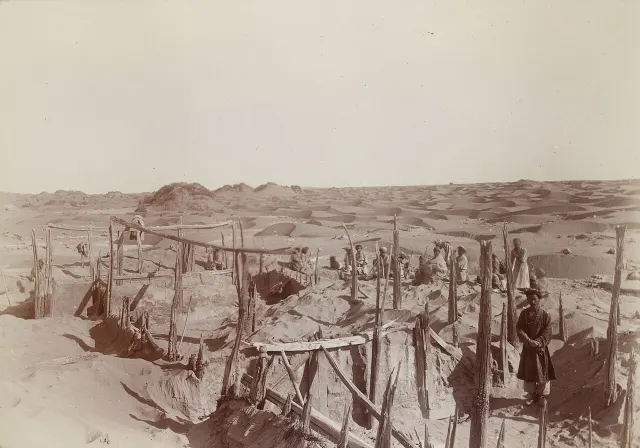
They are the records of the kingdom of Shanshan in the 3rd century, found at Niya, Loulan and Khotan; Aurel Stein first found them at Niya in January 1901.



What do the tablets say?
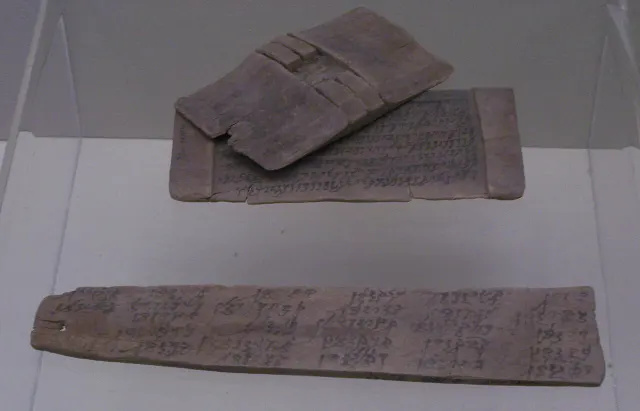
The business of running a small oasis kingdom 1,700 years ago: orders from the king to his officials, reports, complaints, contracts and receipts, among them the sale of a camel. They are written in an Indian script, Kharoshthi, and in a Prakrit language from the north-west of India, which the kingdom of Shanshan (Kroraina) used for its government in the 3rd century. At Loulan, Stein found that the dated documents from one rubbish heap all fell within the years 264–270, with two papers of 312.
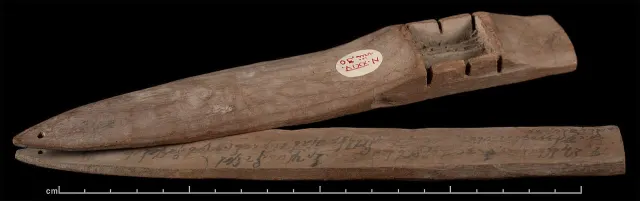
The tablets themselves are clever objects. A letter was written on two wedge-shaped or oblong boards that fitted together, tied with string and sealed with clay so that no one could read it without breaking the seal. Many of the clay seals show figures from Greek art: Stein chose an armed Pallas Athena from one of them as the emblem of his book. An Indian script, a Greek goddess and Chinese silk, all in one desert rubbish heap: Niya shows how many worlds met in the Tarim.
Sources: Stein, Ancient Khotan (1907) · Stein, Serindia (1921) · Hiroshi Kumamoto, “Khotan ii. History in the Pre-Islamic Period”, Encyclopaedia Iranica (2009)
Sources (3)
- Stein, Ancient Khotan (1907) · public domain
- Stein, Serindia (1921) · public domain
- Hiroshi Kumamoto, “Khotan ii. History in the Pre-Islamic Period”, Encyclopaedia Iranica (2009) · cited only