manuscript · ≈ 1546
Tarikh-i Rashidi
تارىخى رەشىدى
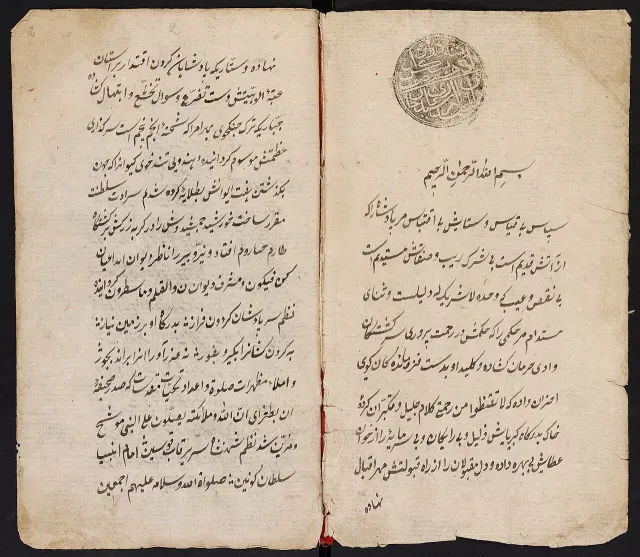
Our main window onto Moghulistan and the early Yarkand Khanate, and at the same time the memoir of a prince who fought, fled and ended as ruler of Kashmir: Mirza Haidar's Persian history of the Moghul khans, finished in Kashmir in 1546 (1547 in its English edition).
Its English translation (1895) is in the public domain.


What is in it?
Two books in one. Mirza Haidar calls the first part the 'real history': the Moghul khans from Tughluq Temür, whose conversion it tells at length, down to his own day. The second part, the 'epitome', is his own life among the last Chaghatayid khans, Babur and the Uzbeks: battles, escapes, campaigns in Tibet and Kashmir, the people he knew. He wrote the second part first, in 1541–42, and finished the first in Kashmir some years later.
The name works twice, he explains: 'Rashidi' recalls the right road (rushd) that Tughluq Temür's Moghuls took when they became Muslims, and it honours the book's patron, Abdurashid Khan, 'the last of the Moghul khakans', who was reigning in Yarkand as he wrote, the same khan who had killed the author's uncle.
Sources: Mirza Muhammad Haidar Dughlat, The Tarikh-i-Rashidi: A History of the Moghuls of Central Asia, tr. E. Denison Ross, ed. N. Elias (London, 1895) · Mehmet Emin Buğra, Şarkî Türkistan Tarihi (1940), in Abdullah Oğuz, Şarkî Türkistan Tarihi: Metin Tenkidi, Türkiye Türkçesi ve İnceleme, MA thesis, İstanbul Üniversitesi (2020)
What does it tell us that no other book does?
Almost everything we know about the Tarim in the 15th and 16th centuries: Millward calls it the main source for the period, Buğra the only one for the Yarkand khanate. It has scenes no other book keeps. Haidar describes the twenty-seven jars dug up in the old citadel of Khotan, each big enough for a man with a quiver to stand in, each holding a copper ewer full of gold dust packed round with bars of silver; one of the ewers came into his own hands, and it took two men to lift it filled with water. He tells how Sultan Abu Bakr built, by his count, more than 12,000 buildings and gardens and raised the walls of Yarkand.
It also records how people felt the land: the 'dam-giri' of the high passes that killed Said Khan, the peace under which a man could ride alone from Hami to Ferghana, the ruined towers that were all that remained of earlier Moghul glory.
Sources: James A. Millward, Eurasian Crossroads: A History of Xinjiang (London: Hurst, 2007) · Mehmet Emin Buğra, Şarkî Türkistan Tarihi (1940), in Abdullah Oğuz, Şarkî Türkistan Tarihi: Metin Tenkidi, Türkiye Türkçesi ve İnceleme, MA thesis, İstanbul Üniversitesi (2020) · Mirza Muhammad Haidar Dughlat, The Tarikh-i-Rashidi: A History of the Moghuls of Central Asia, tr. E. Denison Ross, ed. N. Elias (London, 1895)
How far can we trust it?
As a witness, a great deal; as a judge, with care. Haidar was at many of the events he describes. But he wrote as a Dughlat noble and a Muslim: he gives non-Muslim Moghuls only their names, he praises his patron and kinsman Said Khan at length, and he writes of Abdurashid, who killed his uncle, with open bitterness. He himself warned that his book was 'full of mistakes'.
Even its date is read two ways. Buğra's editor, Abdullah Oğuz, and Isenbike Togan say the first part was finished in Kashmir in 1546; the English translators, who read the date at the end of the book as the last days of Zulhijja, put it in February 1547. That English translation, by E. Denison Ross with notes by N. Elias, appeared in London in 1895 and is now in the public domain, which is why Tarixim can quote it freely.
Sources: Mirza Muhammad Haidar Dughlat, The Tarikh-i-Rashidi: A History of the Moghuls of Central Asia, tr. E. Denison Ross, ed. N. Elias (London, 1895) · Mehmet Emin Buğra, Şarkî Türkistan Tarihi (1940), in Abdullah Oğuz, Şarkî Türkistan Tarihi: Metin Tenkidi, Türkiye Türkçesi ve İnceleme, MA thesis, İstanbul Üniversitesi (2020) · Isenbike Togan, “Chinese Turkestan v. Under the Khojas”, Encyclopaedia Iranica (1991)
Events
Sources (4)
- Mirza Muhammad Haidar Dughlat, The Tarikh-i-Rashidi: A History of the Moghuls of Central Asia, tr. E. Denison Ross, ed. N. Elias (London, 1895) · public domain
- Mehmet Emin Buğra, Şarkî Türkistan Tarihi (1940), in Abdullah Oğuz, Şarkî Türkistan Tarihi: Metin Tenkidi, Türkiye Türkçesi ve İnceleme, MA thesis, İstanbul Üniversitesi (2020) · cited only
- James A. Millward, Eurasian Crossroads: A History of Xinjiang (London: Hurst, 2007) · cited only
- Isenbike Togan, “Chinese Turkestan v. Under the Khojas”, Encyclopaedia Iranica (1991) · cited only