khanate · ≈ 1514 – 1705
Yarkand Khanate
يەكەن (سەئىدىيە) خانلىقى
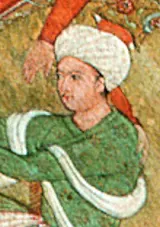
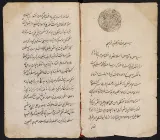
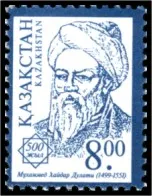
The khanate that ruled East Turkistan for 170 years, at whose court the Twelve Muqam are held to have been arranged, and whose khan was the patron of the Tarikh-i Rashidi.
In its peace, wrote Mirza Haidar, 'any one might travel alone between Kamul or Khitai and the country of Farghana without provision for the journey and without fear'. Sultan Said Khan founded it in 1514 with Yarkand as its capital; the Dzungars, with Afaq Khoja, ended it in 1679 (1678 in other sources).
What was life like under the Yarkand khans?
For long stretches, peaceful and busy with trade. When Said Khan settled in Kashgar and Yarkand in 1514 and came to terms with his brother Mansur, who ruled Turfan and the north-east, Mirza Haidar wrote that 'any one might travel alone between Kamul or Khitai and the country of Farghana without provision for the journey and without fear of molestation'. Caravans went to Ming China under the khans' passports. The Jesuit Bento de Goes, who waited a year in Yarkand in 1603, saw the khan Muhammad Sultan sell the right to lead the caravan to China: the winner paid 200 bags of musk, and the caravan had exactly seventy-two members.
Buğra describes the state from the inside. Yarkand was the capital, with a second government at Turfan for the east. Judges of Islamic law ran courts in every town; taxes were a fixed charge per measure of farmland, a levy on livestock and the zakat on trade. The khan travelled each year to a different part of the country to hear complaints. The army was small, a few thousand men, because, Buğra says, the state's policy was peace, not conquest; only under Abdullah Khan, when the Dzungars grew strong, did it build a larger army.
Sources: James A. Millward, Eurasian Crossroads: A History of Xinjiang (London: Hurst, 2007) · Mehmet Emin Buğra, Şarkî Türkistan Tarihi (1940), in Abdullah Oğuz, Şarkî Türkistan Tarihi: Metin Tenkidi, Türkiye Türkçesi ve İnceleme, MA thesis, İstanbul Üniversitesi (2020)
How did the khanate end?
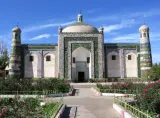
In a quarrel between khans and Sufi masters that let in an outside power. From the late 16th century Naqshbandi khojas from Transoxiana won great influence at the Yarkand court: Khoja Ishaq made the khan Muhammad Sultan his disciple, and a rival line of khojas, later led by Afaq Khoja, built its own following. The khans' family was divided too: Abdullah Khan was defeated by his own son in 1667–68 and left for India, where the Mughal emperor Aurangzeb received him with honour.
When the khan Isma'il, allied with the Ishaqi khojas, drove Afaq Khoja out of Kashgar, Afaq turned to the Dalai Lama, who asked Galdan, the Buddhist ruler of the Dzungars, to help. Galdan conquered the oases and placed Afaq in power in return for a yearly tribute. Buğra, who calls Afaq's act a betrayal, tells of the last stand: the khan Muhammad Emin held Yarkand until Afaq's followers inside opened a gate, and he fell in the sack of the city. So ended a Muslim state of 170 years. The year is given as 1679 by Buğra and 1678 by Togan, Millward and Lurje.
Sources: James A. Millward, Eurasian Crossroads: A History of Xinjiang (London: Hurst, 2007) · Mehmet Emin Buğra, Şarkî Türkistan Tarihi (1940), in Abdullah Oğuz, Şarkî Türkistan Tarihi: Metin Tenkidi, Türkiye Türkçesi ve İnceleme, MA thesis, İstanbul Üniversitesi (2020) · Isenbike Togan, “Chinese Turkestan v. Under the Khojas”, Encyclopaedia Iranica (1991) · Pavel Lurje, “Kashgar”, Encyclopaedia Iranica (2012)
Events
People of this time
Sources (4)
- James A. Millward, Eurasian Crossroads: A History of Xinjiang (London: Hurst, 2007) · cited only
- Mehmet Emin Buğra, Şarkî Türkistan Tarihi (1940), in Abdullah Oğuz, Şarkî Türkistan Tarihi: Metin Tenkidi, Türkiye Türkçesi ve İnceleme, MA thesis, İstanbul Üniversitesi (2020) · cited only
- Isenbike Togan, “Chinese Turkestan v. Under the Khojas”, Encyclopaedia Iranica (1991) · cited only
- Pavel Lurje, “Kashgar”, Encyclopaedia Iranica (2012) · cited only
Years are approximate; they will be checked against a second source.