khanate · ≈ 1347 – 1697
Moghulistan
موغۇلىستان (شەرقىي چاغاتاي)
The khanate in which Chinggis Khan's descendants in the Ili and the Tarim became Muslims, under Tughluq Temür Khan in the 14th century: on one day, says the Tarikh-i Rashidi, 160,000 people cut off their hair and became Muslims.
Its khans later took Turfan from the Buddhist Uyghurs. It was the eastern part of the Chagatai Khanate, where real power often lay with the Dughlat emirs, and it later became the Yarkand Khanate.
How did the Moghuls become Muslims?
In one morning, says the story, and over a century in fact. The Tarikh-i Rashidi tells how Tughluq Temür Khan, newly converted, examined his princes one by one: those who accepted Islam were embraced, those who refused would be killed. One prince, Jaras, agreed only if the shaykh Arshad ad-Din could throw his wrestler, a giant who had once lifted a two-year-old camel. The small shaykh struck the giant in the chest; he fell senseless, came to, and recited the creed at the shaykh's feet. 'On that day,' Mirza Haidar writes, '160,000 persons cut off the hair of their heads and became Musulmans.'
Millward reads it as a mythologised story with a true core: by the middle of the 14th century the Mongols of the Chagatai khanate were largely Muslim, and outside China and Mongolia all the Mongols now were. The Buddhist east took longer. Tughluq Temür's son Khizr Khoja led a holy war against Turfan and Qocho (today Karahoja, near Turfan) in the 1390s, yet Turfan's rulers still sent Buddhist priests as envoys to Beijing in the early 15th century.
Sources: Mirza Muhammad Haidar Dughlat, The Tarikh-i-Rashidi: A History of the Moghuls of Central Asia, tr. E. Denison Ross, ed. N. Elias (London, 1895) · James A. Millward, Eurasian Crossroads: A History of Xinjiang (London: Hurst, 2007)
Who really ran Moghulistan?
The khans reigned; the Dughlat emirs often ruled. Moghulistan was the eastern half of the Chagatai khanate, a land of steppes and oases from the Syr Darya and Lake Balkhash to Turfan. Its khans had to be of Chinggis Khan's line, but the rich Mongol clan of the Dughlats served as their emirs and made and unmade them. A Dughlat emir, Bulaji, brought Tughluq Temür to the throne in 1347 and set him on a white felt; after Tughluq's death another Dughlat, Qamar ad-Din, seized the khanship himself and killed most of Tughluq's sons, while Tamerlane's armies raided as far as Karashahr in 1389.
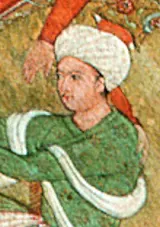
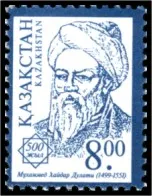
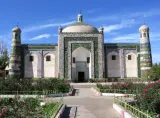
The khanate recovered under Yunus Khan (1462–81), who reunited it with Turfan and surprised a visiting cleric, who had expected a beardless man of the desert, with his full beard and refined speech. In 1514 his grandson Said Khan settled in Kashgar and Yarkand, and the Yarkand Khanate grew out of Moghulistan. One of the Dughlats, Mirza Haidar, wrote its history: almost everything we know of Moghulistan comes from his Tarikh-i Rashidi.
Sources: James A. Millward, Eurasian Crossroads: A History of Xinjiang (London: Hurst, 2007) · Mehmet Emin Buğra, Şarkî Türkistan Tarihi (1940), in Abdullah Oğuz, Şarkî Türkistan Tarihi: Metin Tenkidi, Türkiye Türkçesi ve İnceleme, MA thesis, İstanbul Üniversitesi (2020) · Mirza Muhammad Haidar Dughlat, The Tarikh-i-Rashidi: A History of the Moghuls of Central Asia, tr. E. Denison Ross, ed. N. Elias (London, 1895)
Events
- ≈ 1333The Chaghatai khanate splits in twouprising · Ghulja
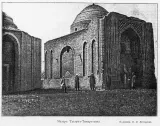
- 1347Islam reaches Kuchaconversion · Mazar of Molana Arshidinhan · disputed
- ≈ 1351Tughluq Temür becomes a Muslimconversion · Mazar of Molana Arshidinhan
- 1389Timur's armies reach Karashahrbattle · Karashahr
- ≈ 1390Khizr Khwaja's holy war on Turfanconversion · Qocho
- 1514Sultan Said Khan takes Kashgarfounding · Kashgar
People of this time
Sources (3)
- Mirza Muhammad Haidar Dughlat, The Tarikh-i-Rashidi: A History of the Moghuls of Central Asia, tr. E. Denison Ross, ed. N. Elias (London, 1895) · public domain
- James A. Millward, Eurasian Crossroads: A History of Xinjiang (London: Hurst, 2007) · cited only
- Mehmet Emin Buğra, Şarkî Türkistan Tarihi (1940), in Abdullah Oğuz, Şarkî Türkistan Tarihi: Metin Tenkidi, Türkiye Türkçesi ve İnceleme, MA thesis, İstanbul Üniversitesi (2020) · cited only
Years are approximate; they will be checked against a second source.