khanate · ≈ 1678 – 1755
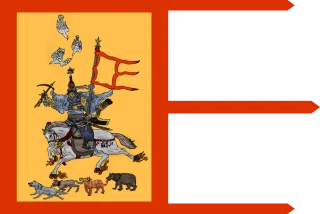
Dzungar Khanate
جۇڭغار خانلىقى
The last steppe empire: the Oirat Mongol khanate that took the Tarim oases in 1679 (1678 in other sources) and taxed them for eighty years, until the Qing destroyed it, and most of the Dzungars with it, in 1755–1759.
How did the Dzungars build an empire?
Not as raiders but as state-builders. The Dzungars were a confederation of Oirat Mongol tribes that came together north of the Tianshan in the early 17th century. They built stone-walled towns, cast guns with the help of Russians and of Swedes who had served Russia, and put small cannon on camels, mobile 'tanks', as Millward calls them. They mined copper and struck coins with the mint name 'Yarkand' in Arabic letters and their khan's name in Oirat script, and printed books in a script a Tibetan lama had made for their language.
Tibet was the other half of their power. In 1640 their chief Batur Khongtaiji took part in the congress of Mongol and Oirat tribes whose law code made Tibetan Buddhism the religion of the Mongols, and his son Galdan went to Lhasa as a novice monk. When Galdan returned and took the Tarim oases in 1679 (1678 in other sources), the empire gained what it lacked: a settled, tax-paying south.
Sources: James A. Millward, Eurasian Crossroads: A History of Xinjiang (London: Hurst, 2007) · Mehmet Emin Buğra, Şarkî Türkistan Tarihi (1940), in Abdullah Oğuz, Şarkî Türkistan Tarihi: Metin Tenkidi, Türkiye Türkçesi ve İnceleme, MA thesis, İstanbul Üniversitesi (2020)
How did the Dzungars rule the Tarim oases?
From a distance, and for the revenue. Millward compares them to the Qara Khitay: they did not so much govern the oases as extract from them. The khojas sat in the cities as the Dzungars' men, and Kashgar alone owed 48,000 ounces of silver a year by one account, about 41,000 ounces and 67,000 patman of grain by a Qing report, besides cotton, saffron, labour and taxes on mills, stills and trade. Each harvest Dzungar bands came to collect, and had to be fed, wined and given women.
Buğra describes the same years as a tyranny the land had never seen before: the real power lay with Dzungar officers and troops, the khojas only flattered them, and whenever people rose, their leaders, scholars and nobles were killed. The Dzungars also moved Muslim farmers from the Tarim north to the Ili valley to grow their grain. With these 'Taranchis' began the settlement of the north by the Turkic Muslims who would later be called Uyghurs.
Sources: James A. Millward, Eurasian Crossroads: A History of Xinjiang (London: Hurst, 2007) · Mehmet Emin Buğra, Şarkî Türkistan Tarihi (1940), in Abdullah Oğuz, Şarkî Türkistan Tarihi: Metin Tenkidi, Türkiye Türkçesi ve İnceleme, MA thesis, İstanbul Üniversitesi (2020)
How did the Dzungar khanate end?
In a succession quarrel that the Qing turned into an extermination. After the khan Galdan Tsering died in 1745, the confederation split. In 1752 the chiefs Amursana and Dawachi killed the reigning khan; when Dawachi made himself khan, Amursana fled to the Qing with 20,000 followers. The Qianlong emperor sent armies with him, and in 1755 they took Dzungaria almost without a fight. But Amursana wanted all the Dzungar lands for himself; he rose and killed the Qing troops left in Ghulja.
Qianlong's answer, Millward writes, was to urge his generals to kill all the Dzungars except women, children and the old, who were to be enslaved. Hunger, smallpox and the scattering of the survivors finished the rest; the name Dzungar disappeared. Peter Perdue calls it a deliberate ethnic genocide. Buğra dates the fall of the khanate to 1757 and writes that the Qing commander burned the towns and left the country an empty desert.
Sources: James A. Millward, Eurasian Crossroads: A History of Xinjiang (London: Hurst, 2007) · Mehmet Emin Buğra, Şarkî Türkistan Tarihi (1940), in Abdullah Oğuz, Şarkî Türkistan Tarihi: Metin Tenkidi, Türkiye Türkçesi ve İnceleme, MA thesis, İstanbul Üniversitesi (2020)
Events
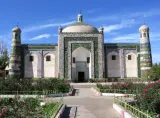
- ≈ 1679The Dzungars take the Tarim oases and put Afaq Khoja in powerfall · Yarkant
- 1696The Battle of Jao Modobattle · Tuul River
- ≈ 1713The Dzungars squeeze the six citiesevent · Kashgar
- 1755The Qing take Dzungariafall · Ghulja
- ≈ 1755The destruction of the Dzungarsfall · Ghulja
- 1759The Qing conquer Kashgariafall · Kashgar
People of this time
Sources (2)
- James A. Millward, Eurasian Crossroads: A History of Xinjiang (London: Hurst, 2007) · cited only
- Mehmet Emin Buğra, Şarkî Türkistan Tarihi (1940), in Abdullah Oğuz, Şarkî Türkistan Tarihi: Metin Tenkidi, Türkiye Türkçesi ve İnceleme, MA thesis, İstanbul Üniversitesi (2020) · cited only
Years are approximate; they will be checked against a second source.
Flag of Dzungar Khanate: HorseBro the hemionus · CC BY-SA 4.0 · Wikimedia Commons
