Stop 5 / 11 · scholar · ≈ 1499 – 1551
Mirza Muhammad Haidar Dughlat
A soldier, a cousin and a historian.
The general who wrote the Tarikh-i Rashidi, the Persian history of the Moghul khans and our main window onto the region in the 14th–16th centuries, and who ended his life as ruler of Kashmir.
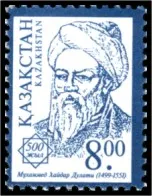
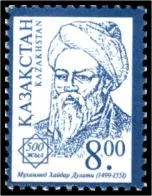

Why did a general write a history?
Because he saw that his people's past was vanishing. When the Moghuls were strong, he writes, learned men wrote their history; but for more than a hundred years no one had done so, and nothing was left of them but a ruined tower here, a college or a minaret there, standing only because the stones had held. 'My object,' he says, 'is simply to write a memoir, that the history of the Moghuls may not be entirely forgotten', so that a later khan could find his own family tree in it.
He was frank about the result: other authors ask pardon for any mistakes, but he would not, 'for I know that my book is full of mistakes from beginning to end'. He also chose what to leave out: of the Moghuls who were not Muslims he gave only the names. Buğra, four centuries later, still calls his Tarikh-i Rashidi the only source for the Yarkand khanate's history.
Sources: Mirza Muhammad Haidar Dughlat, The Tarikh-i-Rashidi: A History of the Moghuls of Central Asia, tr. E. Denison Ross, ed. N. Elias (London, 1895) · Mehmet Emin Buğra, Şarkî Türkistan Tarihi (1940), in Abdullah Oğuz, Şarkî Türkistan Tarihi: Metin Tenkidi, Türkiye Türkçesi ve İnceleme, MA thesis, İstanbul Üniversitesi (2020)
What did he do for the khans of Yarkand?
He led their hardest campaigns. In 1527–28 he went with Abdurashid into Dardistan, today's Hunza, Gilgit and Chitral. In 1532 he and Said Khan's son Iskandar crossed into Ladakh and on to Kashmir; at the Lar defile, where the Kashmiris waited, he took part of the army over a mountain by night to cut off their retreat, and Srinagar was entered without a fight. After the khan turned back, Haidar pushed towards Lhasa with 900 men. Eight days short of it, Buğra writes, eight horses in ten had died of the thin air and the soldiers were walking; he turned aside, raided the country round and came back with 100,000 sheep.
It ended badly. While he was still in Tibet, Said Khan died, and the new khan Abdurashid had Haidar's uncle killed. Haidar did not return to Yarkand: he crossed to Badakhshan and went to Humayun, the Mughal emperor of India.
Sources: Mehmet Emin Buğra, Şarkî Türkistan Tarihi (1940), in Abdullah Oğuz, Şarkî Türkistan Tarihi: Metin Tenkidi, Türkiye Türkçesi ve İnceleme, MA thesis, İstanbul Üniversitesi (2020) · Mirza Muhammad Haidar Dughlat, The Tarikh-i-Rashidi: A History of the Moghuls of Central Asia, tr. E. Denison Ross, ed. N. Elias (London, 1895)
How did he come to rule Kashmir, and how did he die?
He knew the valley from the campaign of 1532. In 1540, after Humayun's defeat at Kanauj, Haidar urged him to take Kashmir as a refuge; Humayun went on towards the Indus but let Haidar try with a small force. The other commanders left him on the way, yet on 21 November 1540 he came down into the valley with a handful of men and took it without a blow. A battle on 2 August 1541 made him its master, and for ten years he ruled it, in the name of a puppet king. Abul Fazl, Akbar's historian, says he found Kashmir in ruin and left it full of fields and towns, but blames him for spending too much time on music.
His mind, Elias notes, stayed beyond the passes: of his own reign he wrote only two short chapters, and much more about Kashgar and Yarkand, where his family and his enemies lived. In the autumn of 1551, marching to help an officer against a revolt, his camp was attacked at night and he was killed by an arrow, perhaps, one account suggests, shot by one of his own men in the dark.
Sources: Mirza Muhammad Haidar Dughlat, The Tarikh-i-Rashidi: A History of the Moghuls of Central Asia, tr. E. Denison Ross, ed. N. Elias (London, 1895)
Sources (3)
- Mirza Muhammad Haidar Dughlat, The Tarikh-i-Rashidi: A History of the Moghuls of Central Asia, tr. E. Denison Ross, ed. N. Elias (London, 1895) · public domain
- Mehmet Emin Buğra, Şarkî Türkistan Tarihi (1940), in Abdullah Oğuz, Şarkî Türkistan Tarihi: Metin Tenkidi, Türkiye Türkçesi ve İnceleme, MA thesis, İstanbul Üniversitesi (2020) · cited only
- Wikidata · cited only