Stop 8 / 10 · scholar · 1029 – 1073
Mahmud al-Kashgari
A Karakhanid prince who travelled the Turkic lands, collecting words.
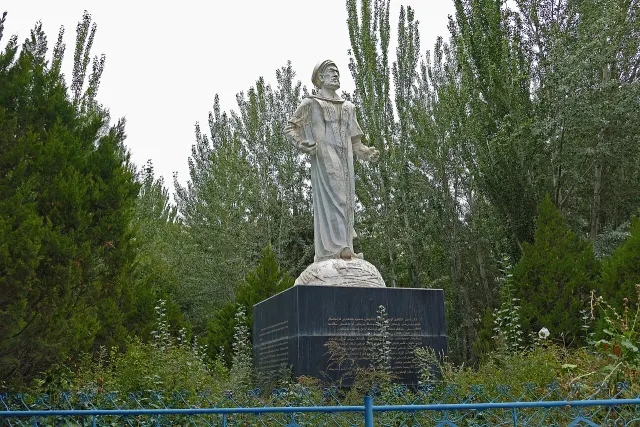
The Kashgar scholar who travelled the Turkic lands collecting words, proverbs and songs and made of them the Dīwān Lughāt al-Turk, the first great book about the Turkic languages. A member of the Karakhanid ruling family, he wrote it in Baghdad in 1072–1074 for the Abbasid caliph. He is buried at Opal, near Kashgar.

How did he gather his words?
On the road. Buğra says Mahmud travelled for years through the Turkic lands, from town to camp, writing down words, proverbs and songs as people actually used them, and noting where each word was said differently. Only then did he sit down in Baghdad to put it all in order, in Arabic, for the caliph's court. He knew Arabic and Persian well, but his subject was his own language.
What he made of it is told on the page of his book, the Diwan. He was a member of the Karakhanid ruling family and studied at the Halik madrasa in Kashgar, the same college as Yusuf Khass Hajib. His grave is at Opal, south-west of Kashgar; it has been restored and is visited by pilgrims and tourists alike.
Sources: James A. Millward, Eurasian Crossroads: A History of Xinjiang (London: Hurst, 2007) · Mehmet Emin Buğra, Şarkî Türkistan Tarihi (1940), in Abdullah Oğuz, Şarkî Türkistan Tarihi: Metin Tenkidi, Türkiye Türkçesi ve İnceleme, MA thesis, İstanbul Üniversitesi (2020)
Sources (4)
- James A. Millward, Eurasian Crossroads: A History of Xinjiang (London: Hurst, 2007) · cited only
- Mehmet Emin Buğra, Şarkî Türkistan Tarihi (1940), in Abdullah Oğuz, Şarkî Türkistan Tarihi: Metin Tenkidi, Türkiye Türkçesi ve İnceleme, MA thesis, İstanbul Üniversitesi (2020) · cited only
- Wikidata · cited only
- Khayr al-Dīn al-Ziriklī, al-Aʻlām, 15th ed. (Beirut: Dār al-ʻIlm lil-Malāyīn, 2002) · cited only