Stop 10 / 11 · ruler · 1626 – 1694
Afaq Khoja
Driven out of Kashgar, a Sufi master seeks help in Lhasa.
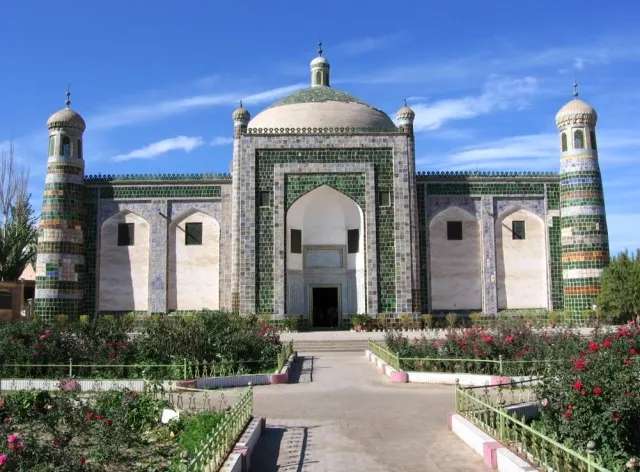
The Sufi master who took power in Yarkand in 1679 (1678 in other sources) with the help of the Buddhist Dzungars, and so handed the Tarim oases to a steppe empire. Driven out of Kashgar, he asked the Dalai Lama for help, and the Dalai Lama wrote to Galdan: 'Isma'il Khan has seized his country.' He led the Afaqi (Aqtaghliq) khojas; his mausoleum outside Kashgar is one of the best-known buildings of the region. He died in 1694.

Why did Afaq Khoja call in the Dzungars?
Because he had lost a struggle for power in Kashgar and Yarkand. Afaq Khoja, whose given name was Hidayat Allah, came from a line of Naqshbandi Sufi masters, the Makhdumzadas of Transoxiana. His father Muhammad Yusuf had preached in the Tarim and Turfan basins, and, says Millward, was poisoned by jealous rivals of the other branch, the Ishaqiyya. Afaq was a powerful figure in Kashgar until the 1670s, perhaps even its governor, until the khan Isma'il, allied with the Ishaqis, drove him out.
The sources tell what happened next in two ways. In Millward's account, drawn from the hagiography of the khojas, Afaq fled to Kashmir and then to Lhasa, presented himself to the Fifth Dalai Lama as the rightful ruler of Kashgaria and won his help: 'Isma'il Khan has seized his country', the Dalai Lama wrote to Galdan, the Dzungar ruler, who then conquered the oases and put Afaq and his sons in power in return for a yearly payment. In Buğra's account Afaq, as Hidayatullah Hoca, first rose in open revolt around 1676–77, briefly seized Yarkand, lost it again, and fled to Galdan in the Ili, who gave him the honorific 'Abak'. Buğra holds that 'Afaq', 'of the horizons', is his followers' reshaping of that Dzungar title.
Sources: James A. Millward, Eurasian Crossroads: A History of Xinjiang (London: Hurst, 2007) · Mehmet Emin Buğra, Şarkî Türkistan Tarihi (1940), in Abdullah Oğuz, Şarkî Türkistan Tarihi: Metin Tenkidi, Türkiye Türkçesi ve İnceleme, MA thesis, İstanbul Üniversitesi (2020)
What did his choice change?
It ended the Yarkand Khanate and put the Tarim oases under a steppe empire for eighty years. Millward describes the result as an old pattern returning: local rulers in the oases, now a line of Sufis, paying tribute to nomad overlords north of the Tianshan. Buğra, writing in 1940, judges Afaq harshly: in his telling the khojas repaid the khans' generosity with ingratitude, and Afaq's followers opened the gates of Yarkand to Galdan's army. This site shows both readings side by side.
The feud he stood for outlived him. After his death in 1694 his widow, remembered as 'Jallad Khanum', the Butcher Queen, pressed the war against the Ishaqis. Kirghiz tribes in the mountains joined both sides, which is why the Afaqis are also called Aqtaghliq, 'White Mountain', and the Ishaqis Qarataghliq, 'Black Mountain'. The rivalry went on through the Qing conquest and the 19th century, when Afaqi khojas such as Jahangir led risings from Kokand. Afaq's mausoleum outside Kashgar, an important Naqshbandi tomb, remains one of the best-known buildings of the region; Yaqub Beg restored and endowed it in the 1870s.
Sources: James A. Millward, Eurasian Crossroads: A History of Xinjiang (London: Hurst, 2007) · Mehmet Emin Buğra, Şarkî Türkistan Tarihi (1940), in Abdullah Oğuz, Şarkî Türkistan Tarihi: Metin Tenkidi, Türkiye Türkçesi ve İnceleme, MA thesis, İstanbul Üniversitesi (2020)
Sources (4)
- James A. Millward, Eurasian Crossroads: A History of Xinjiang (London: Hurst, 2007) · cited only
- Mehmet Emin Buğra, Şarkî Türkistan Tarihi (1940), in Abdullah Oğuz, Şarkî Türkistan Tarihi: Metin Tenkidi, Türkiye Türkçesi ve İnceleme, MA thesis, İstanbul Üniversitesi (2020) · cited only
- Wikidata · cited only
- Isenbike Togan, “Chinese Turkestan v. Under the Khojas”, Encyclopaedia Iranica (1991) · cited only