explorer · 1862 – 1943
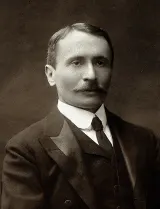
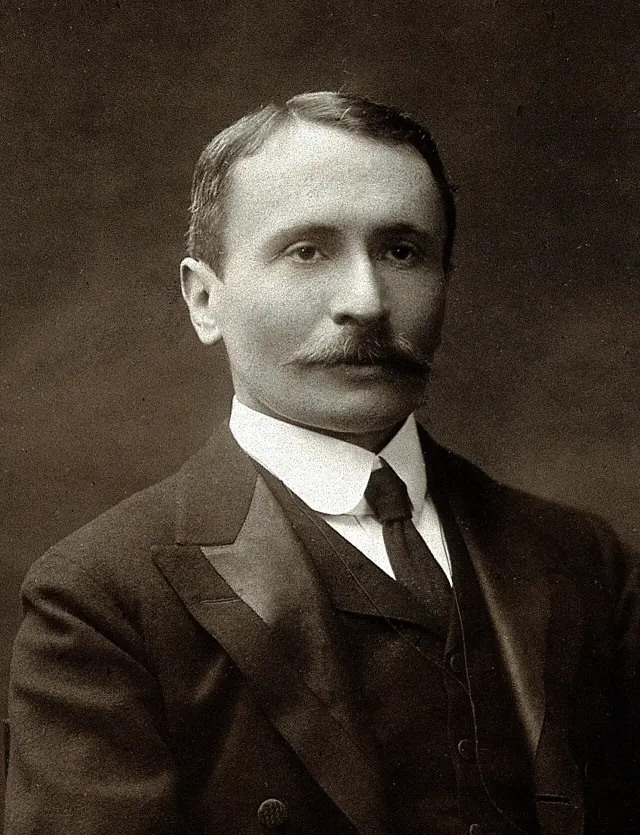
Aurel Stein
ئاۋرېل ستېين
The archaeologist whose digs at Dandan Oilik, Niya, Miran and the Dunhuang library showed the Silk Road oases from within, and who took almost everything he found to London and New Delhi.
Hungarian-born and in British Indian service, he came three times between 1900 and 1916. His finds are now in the British Museum and the British Library in London and the National Museum in New Delhi.

Life and works
- 1862BornAurel Stein
- 1914expeditionStein digs in QochoBritain's share of the Turfan finds: Stein's months at Qocho.
- 1943DiedAurel Stein
Which ruins did he dig, and what did he find?
Stein came three times. On the first journey (1900–01) he worked around Khotan. At Dandan Oilik, a Buddhist town swallowed by the sand, he found painted wooden panels, among them the 'silk princess' who smuggled silkworm eggs to Khotan in her headdress. At Niya, a settlement abandoned in the 3rd–4th century, he pulled hundreds of wooden tablets out of the rubbish heaps, written in the Indian Kharoshthi script: the archive of the kingdom of Shanshan.
On the second journey (1906–08) he went east along the southern route: back to Niya, then to Loulan and Miran near Lop Nur. At Miran a Tibetan fort gave up hundreds of documents, and a Buddhist shrine had wall paintings close to Greco-Roman art. In May 1907, at the Caves of the Thousand Buddhas near Dunhuang, he was the first European to enter a library that had been walled up for nearly nine hundred years, and he took away twenty-four cases of manuscripts, in Chinese, Sanskrit, Khotanese, Kuchean, Sogdian, Uyghur, runic Turkic and Tibetan, and five more of paintings and textiles. On the third journey (1913–16) he dug at Qocho (today Karahoja, near Turfan) and other sites of the Turfan oasis.
Sources: Stein, Ancient Khotan (1907) · Stein, Serindia (1921) · Werner Sundermann, “Turfan Expeditions”, Encyclopaedia Iranica (2004)
What did his finds teach us?
Before Stein, the early history of the Tarim was known mostly from Chinese annals, written from the outside. His finds showed the oases from within: kingdoms that wrote in Indian scripts and languages, prayed to the Buddha, painted in styles that mixed India, Iran and the Mediterranean, and traded with China. The Niya tablets show daily life in the 3rd century: orders from officials, contracts, complaints, even the sale of a camel. Millward calls the work of Stein and the other explorers the first material evidence of the early exchange of goods and ideas between India, China and the Mediterranean, the history the name 'Silk Road' stands for.
The Dunhuang library alone opened whole fields of study. Languages that had been forgotten, such as Khotanese and Kuchean, could now be read from many texts, and the hundreds of paintings on silk, Stein wrote, opened a new chapter in the history of Buddhist art.
Sources: James A. Millward, Eurasian Crossroads: A History of Xinjiang (London: Hurst, 2007) · Stein, Serindia (1921) · Stein, Ancient Khotan (1907)
Why is he controversial?
Stein took almost everything he found out of the country. He did it with the leave of local officials of the time, but critics stress that nobody asked the people whose past it was, and that Wang Yuanlu, the Taoist keeper of the Dunhuang cave, was paid a small sum for a whole library. In China he is remembered as one of the 'foreign devils' who plundered the Silk Road; in Britain he was knighted. Hopkirk's well-known book tells both sides.
Why are the finds split between London and New Delhi? Stein's journeys were paid for by the Government of India, and the British Museum paid two-fifths of the cost of the second one in return for the same share of the finds. So today the Niya tablets and the Dunhuang manuscripts are studied in the British Museum and British Library and in the National Museum in New Delhi, thousands of kilometres from where they were written. Stein kept travelling into old age and died in Kabul in 1943.
Sources: Tachibana Zuichō's work for the Ōtani expeditions; Hopkirk, Foreign Devils on the Silk Road (1980) · Stein, Serindia (1921) · Werner Sundermann, “Turfan Expeditions”, Encyclopaedia Iranica (2004) · Wikidata
Sources (6)
- Stein, Ancient Khotan (1907) · public domain
- Stein, Serindia (1921) · public domain
- Werner Sundermann, “Turfan Expeditions”, Encyclopaedia Iranica (2004) · cited only
- James A. Millward, Eurasian Crossroads: A History of Xinjiang (London: Hurst, 2007) · cited only
- Tachibana Zuichō's work for the Ōtani expeditions; Hopkirk, Foreign Devils on the Silk Road (1980) · cited only
- Wikidata · cited only
Years confirmed by two sources.