khanate · ≈ 1697 – 1930
Kumul Khanate (under the Qing)
قۇمۇل خانلىقى (چىڭ سۇلالىسىگە تەۋە)
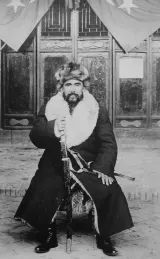
The Uyghur princes of Kumul, who kept their own small state under the Qing for more than two centuries, and whose abolition after the death of the last khan, Maqsud Shah, set off the rising of 1931. It lasted from 1697 to 1930.
How did the princes of Kumul keep a state of their own under the Qing?
By having been on the winning side. The rulers of Kumul and Turfan had helped the Qing in its wars against the Dzungars, and in return they were made 'princes' (wang) under the same system the Qing used for Mongol chiefs. They paid no taxes to the state, held titles like members of the Qing royal house, kept their own retainers, and ruled the people of their lands as serfs. Their families also supplied the highest Muslim officials for other cities of the Tarim. When the Qing came back in the 1870s, the prince of Kumul helped Zuo Zongtang, as his ancestors had helped the Qianlong emperor, and kept his lands and serfs even after Xinjiang became a province in 1884.
The last of them, Maqsud Shah, travelled to Beijing for audiences and sent the court melons as tribute; he spoke Chinese and laid out his palace garden like a Beijing garden. Kul counts some 25,000–30,000 Uyghurs in the principality in 1928, with 21 begs under the prince and a Uyghur guard said to be better trained than the Chinese troops. Kul argues that the Chinese word wang should be rendered 'bey', a principality, not a khanate.
Sources: James A. Millward, Eurasian Crossroads: A History of Xinjiang (London: Hurst, 2007) · Ömer Kul, Osman Batur ve Doğu Türkistan Millî Mücadelesi (1941–1951), doctoral thesis, İstanbul Üniversitesi (2009)
Why did its abolition set off a rising?
Because the people who had complained about the prince found the new order worse. The prince's corvée had long been resented: in 1907 about a thousand Uyghur peasants came to his compound demanding to be treated like the Chinese settlers, as rent-payers rather than serfs, and in 1912 Hami Uyghurs rose under a leader named Timur. When Maqsud Shah died, the governor Jin Shuren abolished the principality, in 1931 according to Kul (1930 in Forbes and Millward), and split it into three counties with old Han-dynasty names.
Urumchi at once levied double farm taxes for the first year. Land left fallow by Uyghur farmers was taken and handed, with seed, tools and two tax-free years, to Han refugees fleeing famine in Gansu; the Uyghurs got unwatered land at the desert's edge. In February 1931, at a village outside Hami, a Chinese tax collector forced a Uyghur father to give him his daughter in marriage; during the wedding, angry Uyghurs killed him and his men. The mob stormed the police posts of the county, and the Kumul rising began, soon led by two of the late prince's ministers, Khoja Niyaz and Yulbars Khan.
Sources: James A. Millward, Eurasian Crossroads: A History of Xinjiang (London: Hurst, 2007) · Ömer Kul, Osman Batur ve Doğu Türkistan Millî Mücadelesi (1941–1951), doctoral thesis, İstanbul Üniversitesi (2009)
Events
People of this time
Sources (2)
- James A. Millward, Eurasian Crossroads: A History of Xinjiang (London: Hurst, 2007) · cited only
- Ömer Kul, Osman Batur ve Doğu Türkistan Millî Mücadelesi (1941–1951), doctoral thesis, İstanbul Üniversitesi (2009) · cited only
Years are approximate; they will be checked against a second source.