statesman · 1912 – 1949 most likely
Ehmetjan Qasim
ئەخمەتجان قاسىمى
The most influential leader of the East Turkistan Republic (1944–1949); after the 1946 peace agreement he became vice-chairman of the provincial coalition government.
He set out for Beijing in August 1949 and was not heard from again. The official account says he died in a plane crash; other sources disagree.
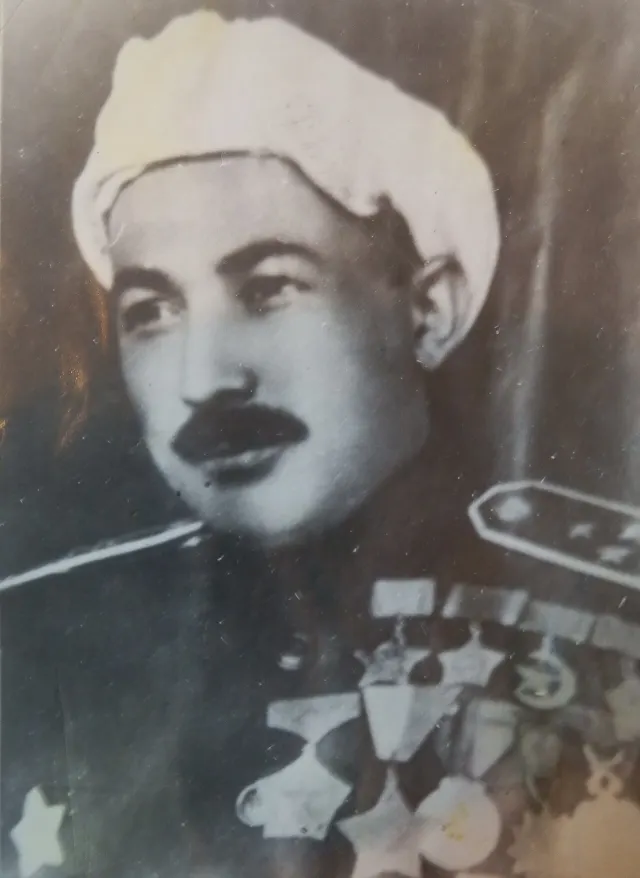

Life and works
- 1912BornGhulja
- 1946agreementA peace agreement and a coalition governmentA peace that made Uyghur and Kazakh official languages and gave the Ghulja leaders a share of power over all Xinjiang.
- 1949eventThe Ghulja leaders vanish on the way to BeijingThe disappearance of the Ghulja leaders, which ended the second republic's hopes of autonomy.
- 27 August 1949 · disputedDiedburied here: Ghulja
What did he want?
Self-rule for the Turkic peoples of Xinjiang, by the means at hand. A Soviet-educated Uyghur from the Ili valley who had spent time in Sheng Shicai's prisons, he rose in the spring of 1945 to lead the secular, pro-Soviet wing of the Ghulja republic, after religious leaders such as Elihan Töre had started the rising. He negotiated the 1946 peace with the Nationalist envoy Zhang Zhizhong and became vice-chairman of a coalition government for all Xinjiang, with Uyghur and Kazakh as official languages.
When the coalition broke down in 1947 he went back to Ghulja and in effect ran the republic again, through a single party, the Union for the Defence of Peace and Democracy. The three districts did comparatively well under it, sheltered from China's inflation. His group welcomed Mongols, Manchus and Russians as citizens and ministers. Millward suggests that even Ehmetjan saw the Soviet alliance as a means rather than an end. In 1949 he publicly called the earlier declaration of an independent East Turkistan 'absolutely mistaken'.
Sources: James A. Millward, Eurasian Crossroads: A History of Xinjiang (London: Hurst, 2007) · Linda Benson, The Ili Rebellion: The Moslem Challenge to Chinese Authority in Xinjiang, 1944–1949 (Armonk: M. E. Sharpe, 1990)
What happened to him and his companions?
In August 1949 Mao invited the Ghulja leaders to the founding conference in Beijing. Ehmetjan, Ishaq Beg, Abdulkerim Abbas, the Kazakh Delilhan and Luo Zhi went to Almaty and boarded a plane, and nothing more was heard of them for weeks. In December, after the army had taken northern Xinjiang, the Chinese authorities said the plane had crashed near Lake Baikal on 27 August, killing everyone. A new delegation under Saypidin Azizi went in their place and dropped the call for autonomy.
The official account of a crash is the one Forbes, Millward and Kul follow, and it is shown here as the most widely accepted. But others disagree: a former deputy chairman of the region said in 1984 that there was no crash and that Ehmetjan died in prison in 1962; Kul quotes witnesses who blame Stalin, or Stalin and Mao together. Millward's verdict: both had motive, means and opportunity, and it is also possible the plane simply crashed. The views stand side by side below. His birth year is also disputed: 1912 by Forbes and Kul, 1914 by Wikidata.
Sources: James A. Millward, Eurasian Crossroads: A History of Xinjiang (London: Hurst, 2007) · Ömer Kul, Osman Batur ve Doğu Türkistan Millî Mücadelesi (1941–1951), doctoral thesis, İstanbul Üniversitesi (2009) · Linda Benson, The Ili Rebellion: The Moslem Challenge to Chinese Authority in Xinjiang, 1944–1949 (Armonk: M. E. Sharpe, 1990) · Andrew D. W. Forbes, Warlords and Muslims in Chinese Central Asia (1986)
Disputed · views side by side
Was there really a plane crash?
Most widely accepted view
27 August 1949
The Chinese authorities (December 1949): on 27 August the plane hit a mountain near Lake Baikal and everyone on board died.
James A. Millward, Eurasian Crossroads: A History of Xinjiang (London: Hurst, 2007) · Ömer Kul, Osman Batur ve Doğu Türkistan Millî Mücadelesi (1941–1951), doctoral thesis, İstanbul Üniversitesi (2009)
1950
Dillon (quoted by Ömer Kul): the crash happened in early 1950, with eight people on board.
Ömer Kul, Osman Batur ve Doğu Türkistan Millî Mücadelesi (1941–1951), doctoral thesis, İstanbul Üniversitesi (2009)
A former deputy chairman of the Xinjiang Uyghur Autonomous Region (published 1984): there was no crash; the leaders were arrested when they reached Beijing, and Ehmetjan Qasimi died in prison in 1962.
Linda Benson, The Ili Rebellion: The Moslem Challenge to Chinese Authority in Xinjiang, 1944–1949 (Armonk: M. E. Sharpe, 1990)
İklil Kurban (quoted by Ömer Kul): the crash was a deception; Soviet officials took these men to Almaty.
Ömer Kul, Osman Batur ve Doğu Türkistan Millî Mücadelesi (1941–1951), doctoral thesis, İstanbul Üniversitesi (2009)
Gökçe Yükselen Abdurrezzak (quoted by Ömer Kul): Stalin and Mao planned the crash.
Ömer Kul, Osman Batur ve Doğu Türkistan Millî Mücadelesi (1941–1951), doctoral thesis, İstanbul Üniversitesi (2009)
The other views are shown with their own sources.
Sources (4)
- James A. Millward, Eurasian Crossroads: A History of Xinjiang (London: Hurst, 2007) · cited only
- Linda Benson, The Ili Rebellion: The Moslem Challenge to Chinese Authority in Xinjiang, 1944–1949 (Armonk: M. E. Sharpe, 1990) · cited only
- Ömer Kul, Osman Batur ve Doğu Türkistan Millî Mücadelesi (1941–1951), doctoral thesis, İstanbul Üniversitesi (2009) · cited only
- Andrew D. W. Forbes, Warlords and Muslims in Chinese Central Asia (1986) · cited only
Years confirmed by two sources. Wikidata gives another year: 1914.